
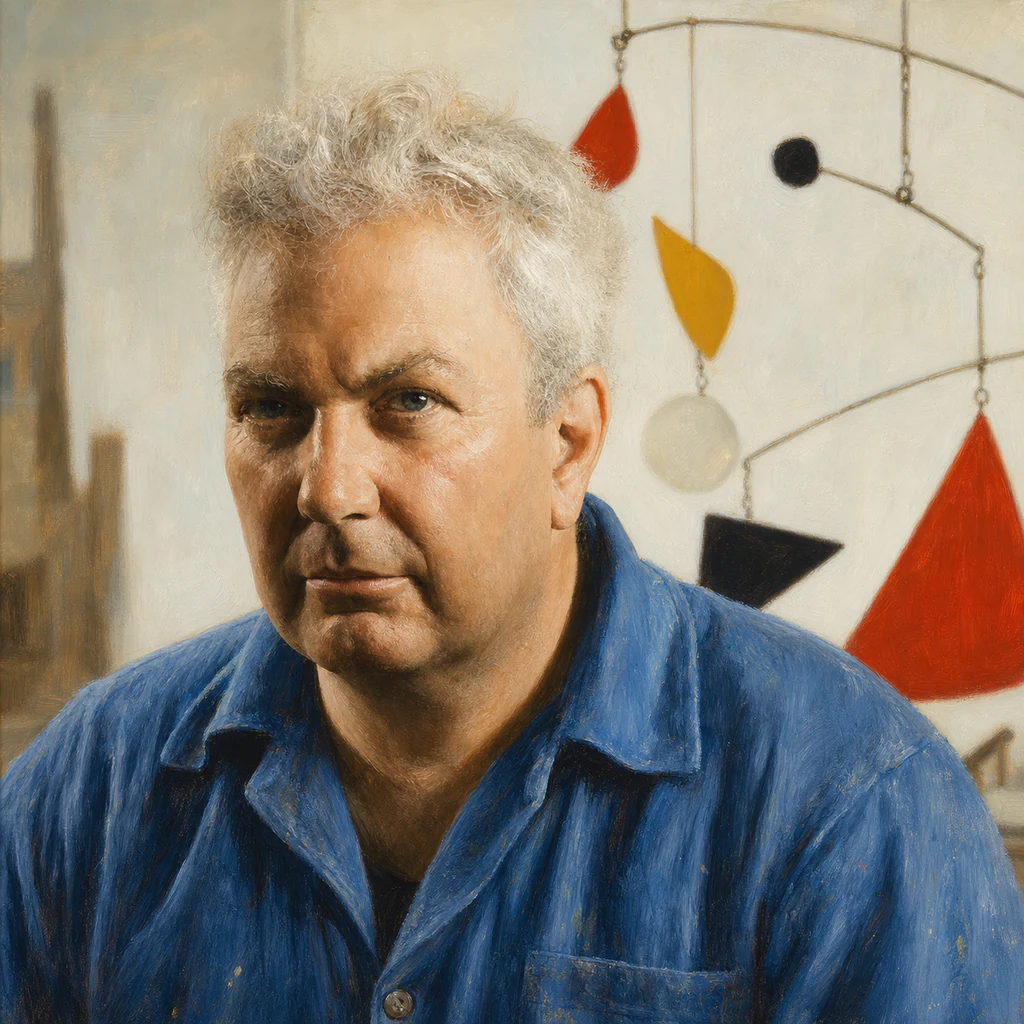
He was an American artist who created moving sculptures called mobiles.
He was an American artist who created moving sculptures called mobiles.
Alexander "Sandy" Calder was born in Lawnton, Pennsylvania, on July 22, 1898, into a family of artists. His father and grandfather were sculptors, and his mother was a painter. As a child, Calder received tools and built toys and small metal animals in his own workshop. Even so, he first chose engineering. He graduated from Stevens Institute of Technology in 1919 with a degree in mechanical engineering.
After several engineering jobs, Calder decided to study drawing and painting at the Art Students League in New York. He sketched athletes, circus performers, and zoo animals for the National Police Gazette. In 1926 he moved to Paris, where he created Cirque Calder: a miniature circus of wire, cloth, cork, and other materials that he operated by hand for audiences.
Calder also bent wire into portraits and figures. He sometimes described this method as drawing in space. The thin lines let viewers see through and around a sculpture instead of looking only at its solid surface.
A 1930 visit to painter Piet Mondrian's studio pushed Calder toward abstract art. He began making sculptures whose parts moved. Artist Marcel Duchamp named these works "mobiles." Some early versions used motors; later ones balanced shapes so air currents set them in motion. Artist Jean Arp called Calder's nonmoving abstract sculptures "stabiles."
Calder did not invent every kind of kinetic art, but his balanced mobiles transformed how artists and audiences thought about sculpture. A work could change from moment to moment as its colored shapes turned, overlapped, and cast moving shadows.
Calder worked in Connecticut and France, making jewelry, prints, paintings, stage designs, and sculpture. In 1943, at age 45, he became the youngest artist then given a retrospective at the Museum of Modern Art. He represented the United States at the 1952 Venice Biennale and won the grand prize for sculpture. Later he created huge public stabiles from painted steel, including La Grande Vitesse in Michigan and Flamingo in Chicago.
Calder died in New York on November 11, 1976. Museums and public spaces around the world continue to display his work. His mobiles look playful, but each depends on careful decisions about weight, distance, shape, and air. Calder's path from mechanical engineering to art shows that science, making, and imagination do not have to live in separate worlds.
Calder's family nickname was Sandy.
At age 11, he made a tiny brass duck that rocked when tapped.
His hand-operated Cirque Calder included dozens of miniature performers and props.
Marcel Duchamp suggested the name "mobiles" for Calder's moving sculptures.
Many of Calder's large outdoor sculptures are called stabiles because they do not move.
3 min read · Independent-reader guide
Think of an answer, then open each card to check.
He was an American artist who created moving sculptures called mobiles.
1898-1976
American
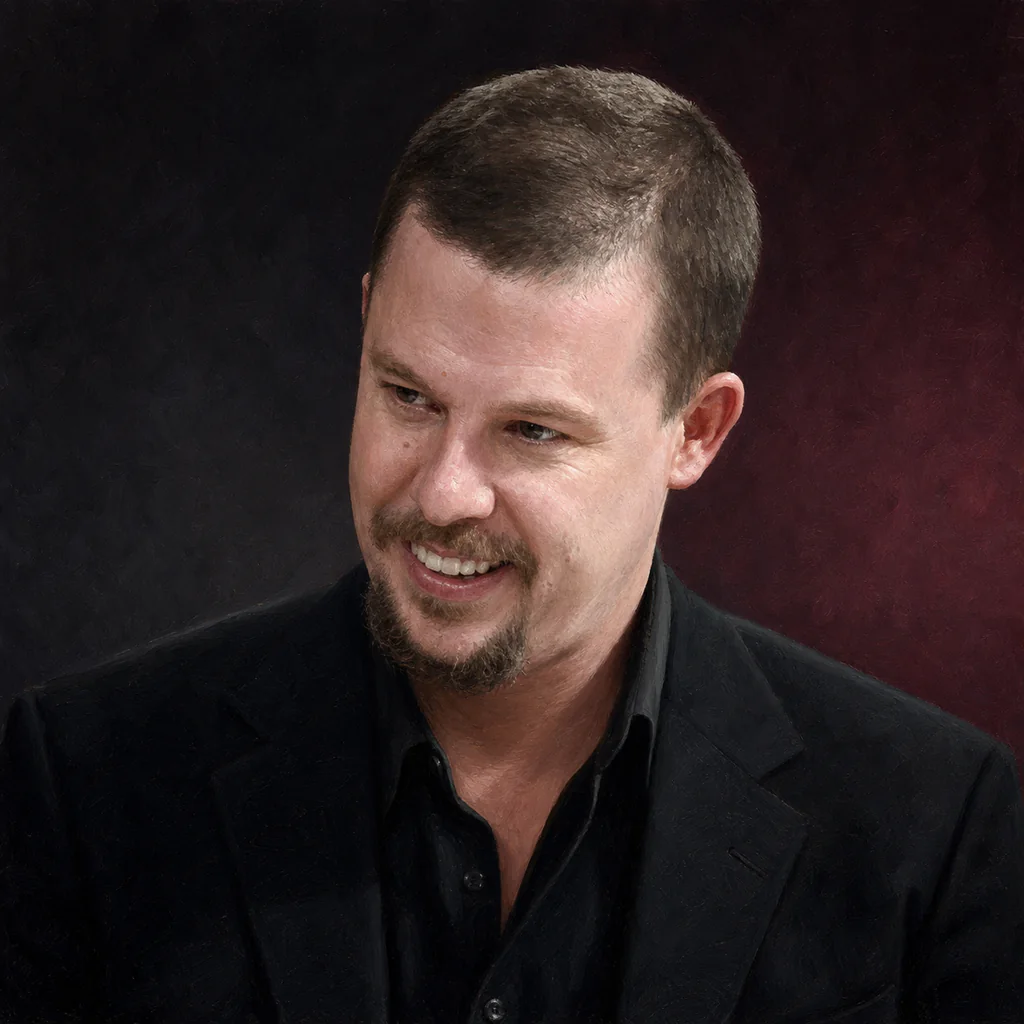
A famous fashion designer who created bold, creative clothing and changed the world of fashion.

Being a famous artist who turned everyday objects into colorful pop art.
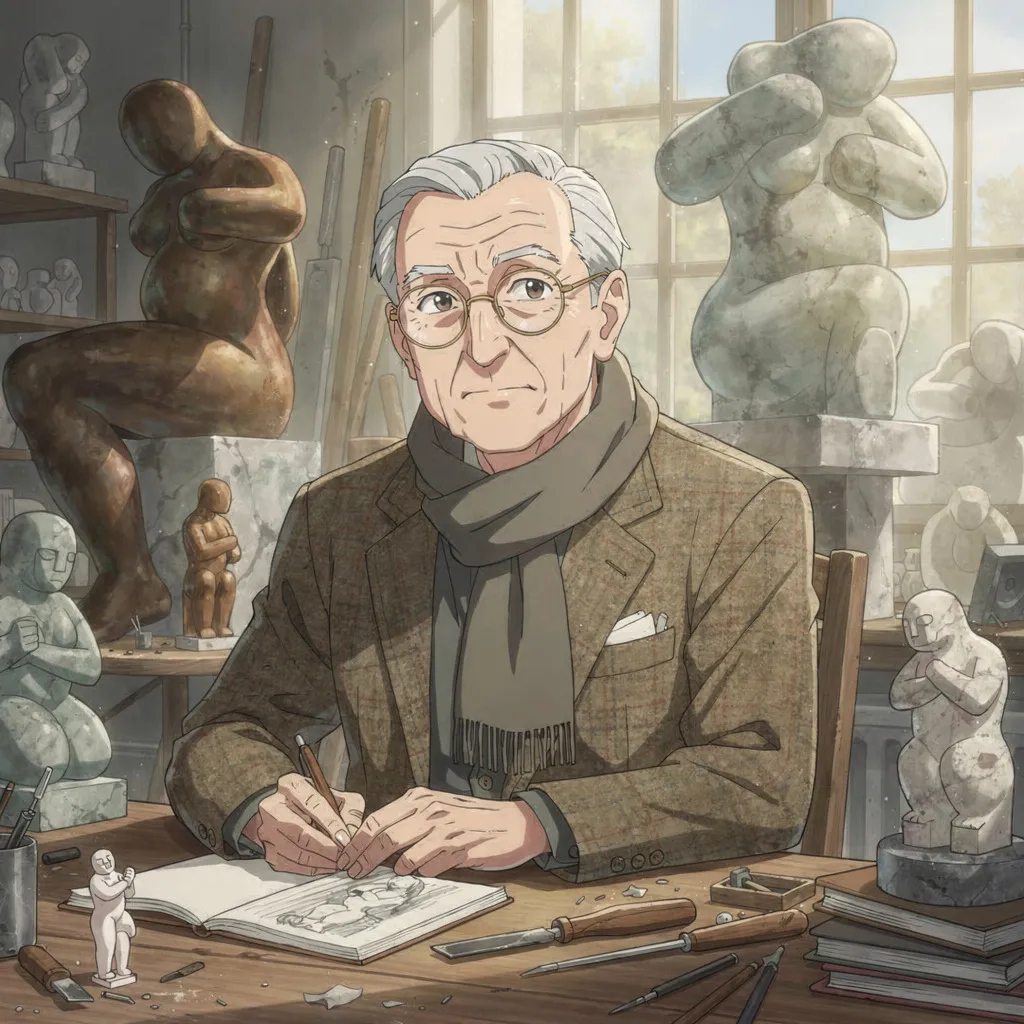
A famous sculptor known for large, smooth sculptures inspired by nature and the human body.
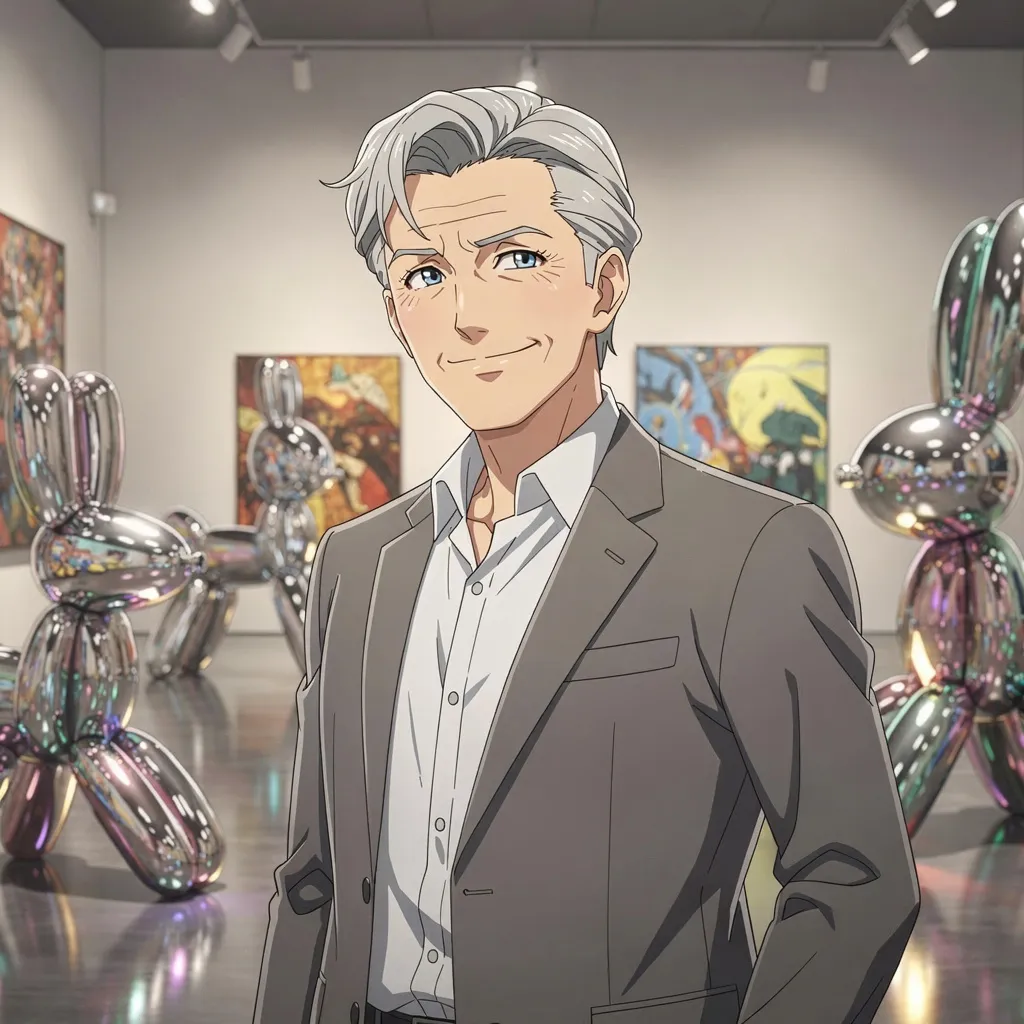
Creating giant, shiny sculptures inspired by everyday objects like balloons and toys.

A famous artist known for his dream-like paintings and melting clocks.
A famous sculptor who helped make modern sculpture popular and expressive.
Explore inspiring lives across science, art, history, music, and more.