
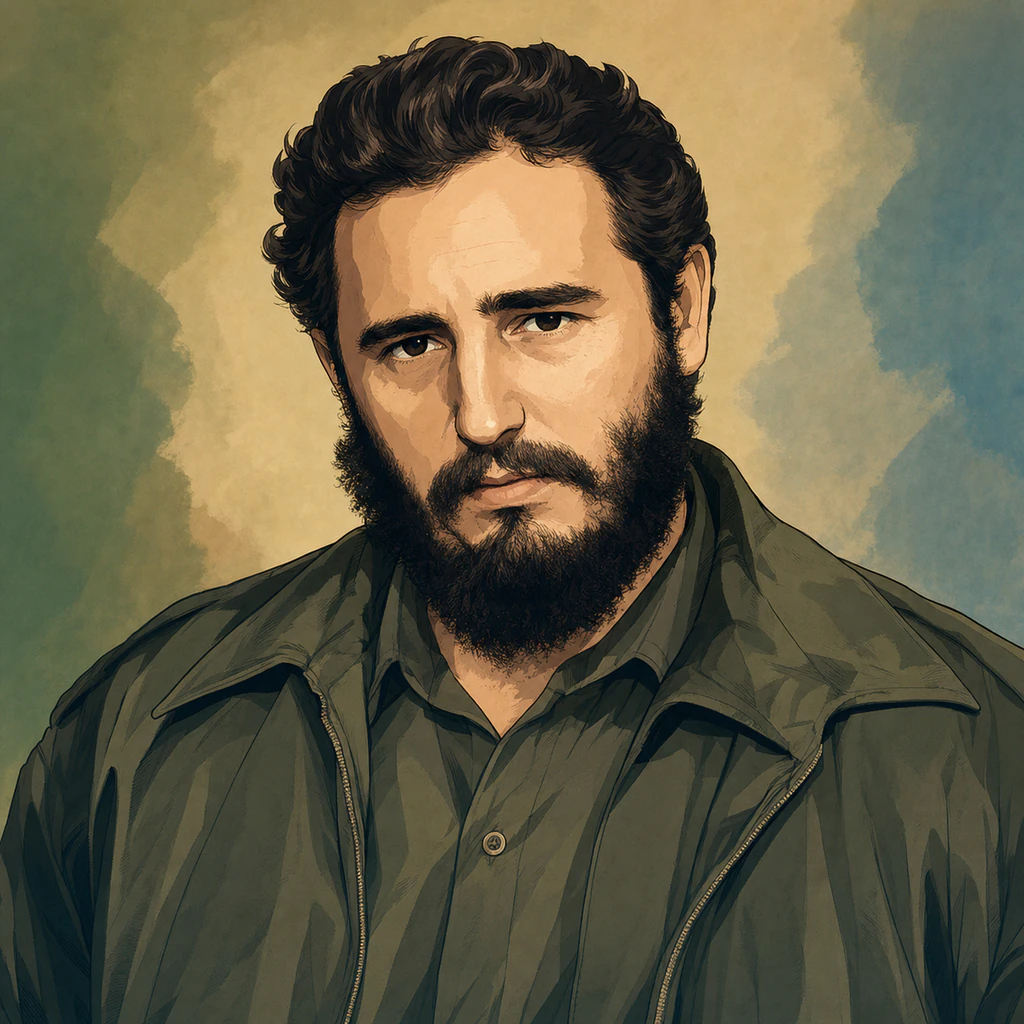
Biography for young readers
Fidel Castro
Being a long-time leader of the country of Cuba
- Lived
- 1926-2016
- From
- Cuban
- Reading time
- About 4 min
- Reading guide
- Independent-reader guide
Watch Fidel Castro's story unfold
Why this story matters
A life worth remembering
Being a long-time leader of the country of Cuba
Think about it
What did you notice?
- Which moment changed the direction of this person's life?
- Which achievement or idea do you think mattered most?
- What is one question you would ask them?
Prefer to read? Open the complete biography transcript
A Law Student Confronts a Dictator
Fidel Castro was 32 when the revolution he led changed Cuba's government and placed the island at the center of world politics. He was born Fidel Alejandro Castro Ruz on August 13, 1926, near Birán in eastern Cuba. His father owned a large sugar farm, and Fidel attended boarding schools before entering the University of Havana in 1945 to study law. Campus politics drew him into debates about corruption, poverty, and Cuba's relationship with the United States.
After graduating, Castro practiced law and entered politics. On March 10, 1952, former president Fulgencio Batista seized power in a military coup and canceled planned elections. Castro first challenged the coup through the courts. When that failed, he decided to organize an armed rebellion—a choice that would bring both dramatic change and great violence.
From Moncada to Havana
On July 26, 1953, Castro and other rebels attacked the Moncada army barracks in Santiago de Cuba. The attack failed; many participants were killed or captured, and Castro was imprisoned. Batista's government released him in a 1955 amnesty. In Mexico, Castro organized the 26th of July Movement with his brother Raúl, Ernesto “Che” Guevara, and other exiles.
Eighty-two rebels sailed for Cuba aboard the crowded yacht Granma in November 1956. After a disastrous landing, the survivors regrouped in the Sierra Maestra mountains. Their guerrilla campaign grew alongside resistance by students, workers, and other opponents of Batista. Batista fled Cuba on January 1, 1959. Castro entered Havana a week later and became prime minister on February 16.
Revolution and Cold War Danger
Castro's government redistributed land, nationalized many businesses, and expanded state-run schools and health services. Cuba's 1961 literacy campaign sent young volunteers across the country to teach reading and writing. Supporters praised these programs and the revolution's promise of national independence. At the same time, Castro built a one-party communist state. Independent newspapers and political parties were shut down, critics were jailed or forced into exile, and Cubans could not choose between competing parties in national elections.
Relations with the United States collapsed as Cuba took U.S.-owned property, the United States imposed an embargo, and Castro allied Cuba with the Soviet Union. In April 1961, Cuban forces defeated a U.S.-backed exile invasion at the Bay of Pigs. In October 1962, Soviet nuclear missiles in Cuba and a U.S. naval quarantine brought the world close to nuclear war. The Soviet Union removed the missiles after an agreement with the United States.
A Long Rule and a Divided Legacy
Castro remained prime minister until 1976, then served as president of Cuba's Council of State. Soviet support helped Cuba for years, while the U.S. embargo also shaped the island's economy. When the Soviet Union collapsed in 1991, Cuba entered a severe crisis known as the Special Period, with shortages of food, fuel, and electricity. Even during hard times, the government kept its education and health systems, but it continued to restrict speech, organizing, and opposition politics.
Ill health led Castro to transfer authority to Raúl in July 2006. He formally left the presidency in February 2008 and stepped down as Communist Party leader in 2011. Castro died on November 25, 2016, at age 90. His wider contribution remains deeply disputed: he helped overthrow a dictatorship and reshaped education, health, and Cuba's global role, yet he also led an authoritarian system that denied basic political freedoms. Studying his life shows why history must examine both achievements and the human costs of power.
Did you know?
Fun facts about Fidel Castro
-
Castro earned a law degree from the University of Havana before becoming a revolutionary leader.
-
The 26th of July Movement took its name from the failed Moncada Barracks attack on July 26, 1953.
-
Eighty-two revolutionaries crowded onto the yacht Granma for the 1956 voyage from Mexico to Cuba.
-
Cuba's 1961 literacy campaign sent volunteer teachers into cities and remote rural communities.
-
Castro was prime minister before becoming president of Cuba's Council of State in 1976.
Learn & remember
Make the story yours
4 min read · Independent-reader guide
Three things to remember
- Known for: Being a long-time leader of the country of Cuba
- Lived: 1926-2016
- From: Cuban
Words to know
Open a word for a short explanation.
revolution
A major and often rapid change in government or society.
Quick check
What do you remember?
Think of an answer, then open each card to check.
What is Fidel Castro best known for?
Being a long-time leader of the country of Cuba
When did Fidel Castro live?
1926-2016
What place or nationality is connected to this story?
Cuban
Biography
Benito Mussolini
Being the fascist leader (dictator) of Italy from 1922 to 1943
Biography
Joseph Stalin
Leading the Soviet Union during a time of big change and World War II
Biography
Che Guevara
Being a doctor, writer, and revolutionary who played a key role in the Cuban Revolution and became a well-known historical figure.
Biography
Mao Zedong
Helping to found the People’s Republic of China and leading the country for many years
Biography
Queen Elizabeth II
She was the longest-reigning monarch in British history and a symbol of service and duty.
Biography
Camila Cabello
Being a pop singer and songwriter famous for hit songs like "Havana" and "Señorita"
One story at a time
Who will you discover next?
Explore inspiring lives across science, art, history, music, and more.