
Biography for young readers
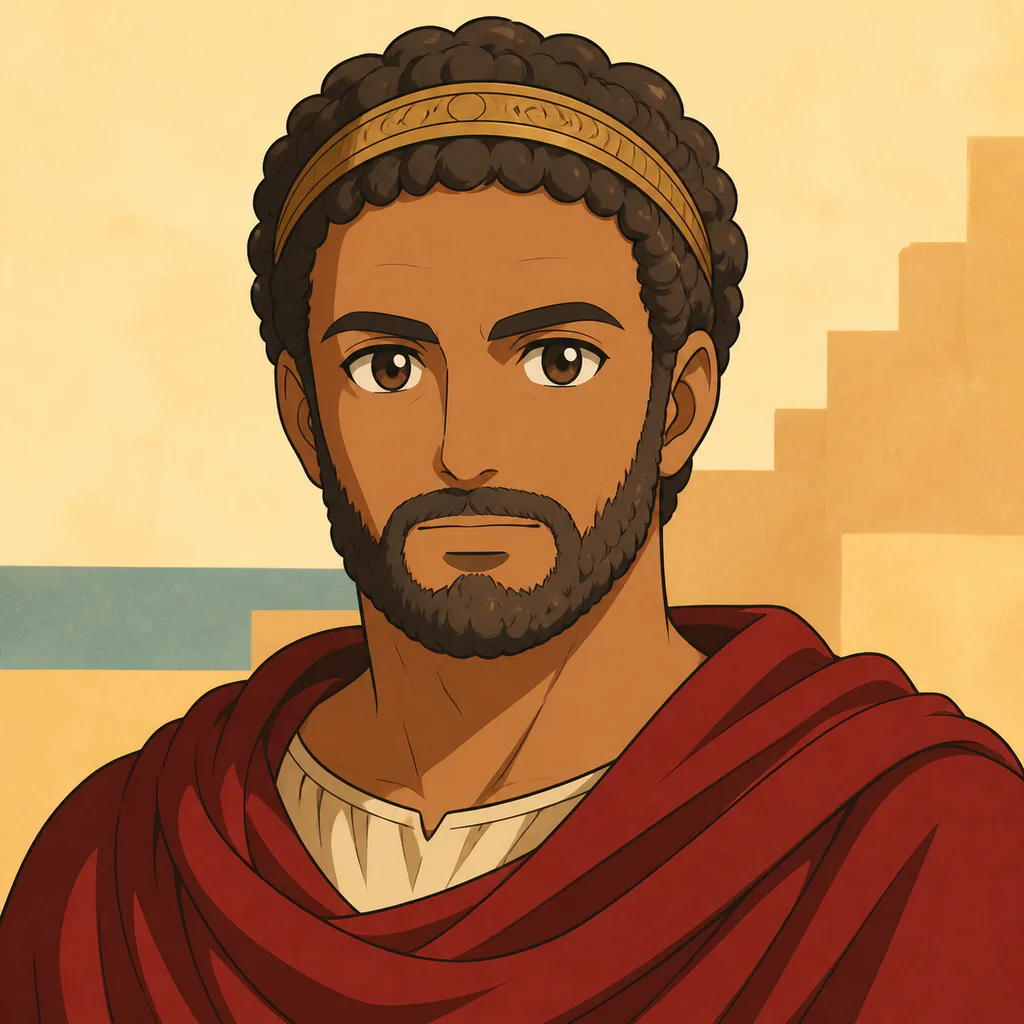
Hannibal Barca
A famous Carthaginian general who led an amazing journey across the Alps with elephants.
- Lived
- 247 BC – 183 BC
- From
- Carthaginian (from the ancient city of Carthage, in North Africa)
- Reading time
- About 3 min
- Reading guide
- Independent-reader guide
Watch Hannibal Barca's story unfold
Why this story matters
A life worth remembering
A famous Carthaginian general who led an amazing journey across the Alps with elephants.
Think about it
What did you notice?
- Which moment changed the direction of this person's life?
- Which achievement or idea do you think mattered most?
- What is one question you would ask them?
Prefer to read? Open the complete biography transcript
From Carthage to Command
Around 247 BCE, Hannibal was born in Carthage, a powerful port city near modern Tunis, Tunisia. Carthage traded across the Mediterranean and competed with the Roman Republic for land and influence. Hannibal's father, Hamilcar Barca, had commanded Carthaginian forces in the First Punic War. Ancient writers say Hannibal accompanied him to Iberia, in parts of present-day Spain and Portugal, while still a boy.
Those writers were Greek and Roman, and no full Carthaginian account of Hannibal's life survives. That means famous childhood stories should be treated as reports, not as details we can prove. What is clearer is that Hannibal served in Iberia and, in 221 BCE, became commander of the Carthaginian army there. He was about 25 years old.
The Road Over the Alps
After Hannibal captured Saguntum in 219 BCE, conflict with Rome grew into the Second Punic War. In 218 BCE, instead of attacking by sea, he led a large, multilingual army from Iberia through southern Gaul and toward Italy. The force crossed rivers, faced attacks, and climbed the Alps as cold weather approached. Soldiers, horses, pack animals, and war elephants struggled through the mountains.
The crossing was daring, but it was also costly: ancient sources give different numbers, and many people and animals did not reach Italy. Historians still debate Hannibal's exact route. What matters is that enough of his army arrived to surprise Rome and win at the Trebia River late in 218 BCE.
Great Victories, but No Surrender
Hannibal defeated another Roman army at Lake Trasimene in 217 BCE. His most famous victory came at Cannae in 216 BCE. He placed troops so the Roman center pushed forward while Carthaginian and allied forces curved around both sides. The maneuver trapped much of the Roman army. It is still called a double envelopment.
Cannae was an extraordinary tactical success and a human disaster, with tens of thousands killed. Hannibal's army included people from North Africa, Iberia, and Gaul, not only Carthaginians. Yet Rome did not surrender. Roman leaders avoided battles that favored Hannibal, attacked Carthaginian power elsewhere, and relied on allies and deep reserves. Hannibal remained in Italy for years, but he lacked the strength to capture Rome and could not force a lasting peace.
Zama, Exile, and a Complicated Legacy
Rome eventually carried the war to North Africa. Carthage recalled Hannibal, and in 202 BCE Scipio Africanus defeated him at Zama. After the war, Hannibal entered Carthaginian public life and worked on political and financial reforms. Roman pressure and enemies at home later drove him into exile. He advised rulers in the eastern Mediterranean and died in Bithynia around 183 or 182 BCE; ancient accounts disagree about some final details.
Hannibal is remembered as an inventive commander, especially for the Alpine crossing and the plan at Cannae. But studying him is not the same as celebrating war. His campaigns caused enormous suffering and did not achieve Carthage's final victory. His wider contribution is a lasting lesson in planning, adaptation, teamwork across languages, and the limits of even brilliant tactics when the larger strategy does not succeed.
Did you know?
Fun facts about Hannibal Barca
-
Hannibal came from Carthage, whose ruins are near modern Tunis, Tunisia.
-
His army crossed the Alps in 218 BCE with soldiers, horses, pack animals, and war elephants.
-
Historians still debate the exact Alpine pass Hannibal used.
-
At Cannae, his army used a surrounding maneuver now called a double envelopment.
-
After his military career, Hannibal served in Carthaginian public life and worked on reforms.
Learn & remember
Make the story yours
3 min read · Independent-reader guide
Three things to remember
- Known for: A famous Carthaginian general who led an amazing journey across the Alps with elephants.
- Lived: 247 BC – 183 BC
- From: Carthaginian (from the ancient city of Carthage, in North Africa)
Quick check
What do you remember?
Think of an answer, then open each card to check.
What is Hannibal Barca best known for?
A famous Carthaginian general who led an amazing journey across the Alps with elephants.
When did Hannibal Barca live?
247 BC – 183 BC
What place or nationality is connected to this story?
Carthaginian (from the ancient city of Carthage, in North Africa)
Biography
Christopher Columbus
Making famous sea voyages that connected Europe and the Americas
Biography
Vercingetorix
A brave Gallic leader who united many tribes of Gaul to stand up to the Roman army led by Julius Caesar.
Biography
Spartacus
He is famous for leading a brave fight for freedom by enslaved people in ancient Rome.
Biography
Ibn Battuta
One of the greatest travelers in history who journeyed across much of the known world.
Biography
Attila the Hun
Being a powerful leader of the Huns and one of the most famous rulers in early European history
One story at a time
Who will you discover next?
Explore inspiring lives across science, art, history, music, and more.