
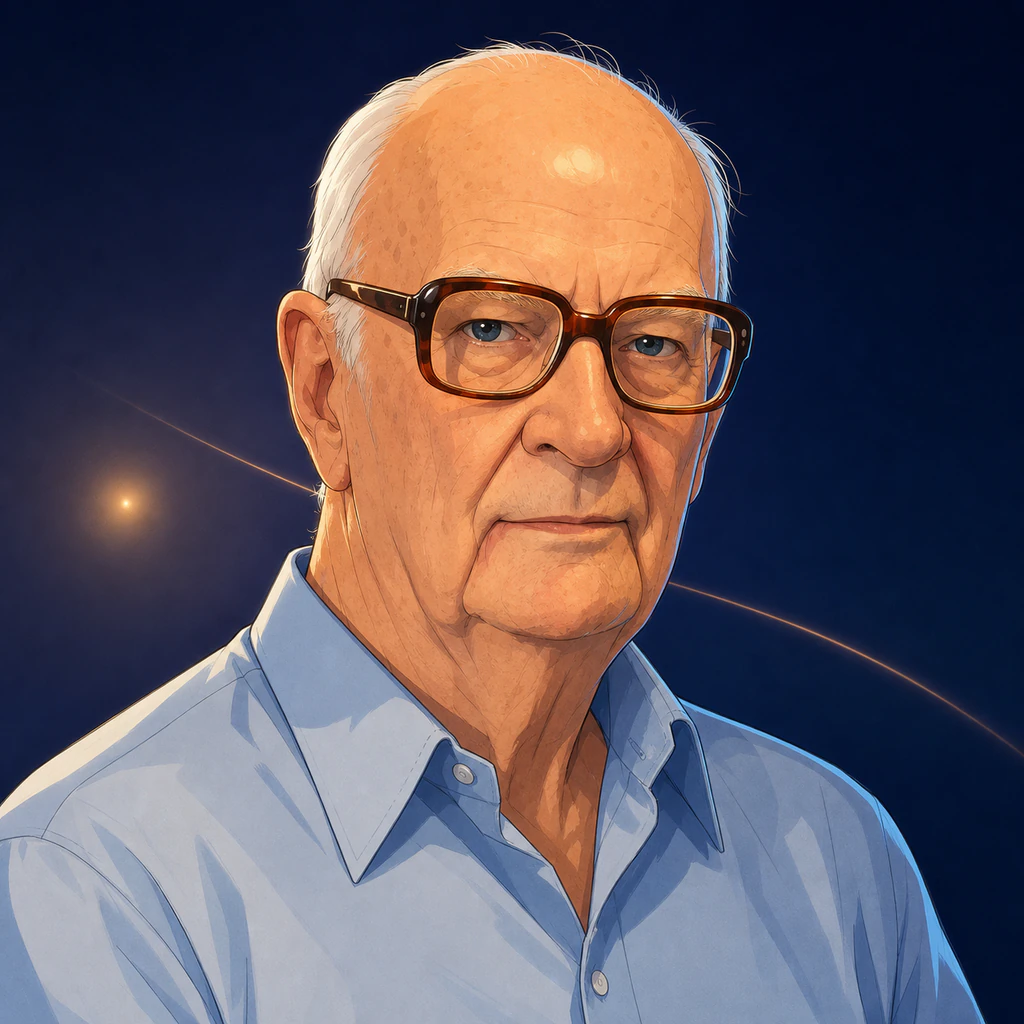
Biography for young readers
Arthur C. Clarke
A famous science fiction writer who imagined the future of space travel and technology
- Lived
- 1917-2008
- From
- British
- Reading time
- About 3 min
- Reading guide
- Advanced vocabulary
Watch Arthur C. Clarke's story unfold
Why this story matters
A life worth remembering
A famous science fiction writer who imagined the future of space travel and technology
Think about it
What did you notice?
- Which moment changed the direction of this person's life?
- Which achievement or idea do you think mattered most?
- What is one question you would ask them?
Prefer to read? Open the complete biography transcript
From a Farm to the Night Sky
On a Somerset farm, young Arthur Clarke could look upward and imagine journeys far beyond Earth. Born in Minehead, England, on December 16, 1917, he collected fossils, watched the night sky, and read science-fiction magazines. By his teens, he was writing about space for the Junior Astronomical Association.
Clarke moved to London in 1936 and found other people who shared his interest in rockets through the British Interplanetary Society. He also worked as a government pensions auditor. Those ordinary office days did not stop his experiments with ideas: he wrote for fan magazines, studied what scientists knew, and asked what future technology might make possible.
Radar, Mathematics, and an Orbital Idea
During World War II, Clarke served in Britain's Royal Air Force as a radar instructor and technician. In 1945, he published a technical article explaining how satellites in high, carefully chosen orbits could relay communications around Earth. Others had described similar orbits earlier, but Clarke showed clearly how they could form a worldwide communications system.
After the war, he earned a first-class degree in mathematics and physics from King's College London in 1948. He then worked at the Institution of Electrical Engineers, helping organize scientific research. His 1950 nonfiction book Interplanetary Flight explained spaceflight for general readers, and its success helped him become a full-time writer.
Stories That Reached the Screen
Clarke did not choose between science and storytelling; he made each strengthen the other. Novels such as Childhood's End (1953) and Rendezvous with Rama (1973) used carefully imagined technology to explore how discovery might change people. His writing could feel hopeful, but it also asked readers to think about responsibility and the unknown.
In the mid-1960s, Clarke collaborated with filmmaker Stanley Kubrick on 2001: A Space Odyssey. The screenplay and Clarke's novel grew from shared work that included ideas from his earlier short fiction. The 1968 film was a drama, not a prediction or documentary, yet its patient view of space helped audiences picture exploration as vast, difficult, and mysterious.
An Ocean Home and a Wider Legacy
Clarke settled in Sri Lanka in the 1950s, where he wrote for the rest of his life. A keen scuba diver, he explored beneath the Indian Ocean as eagerly as he imagined travel above Earth. After post-polio syndrome limited his movement, he continued working from Colombo, using computers to stay connected with readers and researchers.
Clarke received UNESCO's Kalinga Prize for popularizing science and was knighted in 2000. He died in Colombo on March 19, 2008. His wider contribution joins engineering ideas, clear explanations, and bold fiction: he helped people see that imagining a technology is only a beginning, while testing it, building it, and deciding how to use it require many minds.
Did you know?
Fun facts about Arthur C. Clarke
-
As a teenager, Arthur C. Clarke contributed articles about space travel to a Junior Astronomical Association journal called Urania.
-
During World War II, Clarke served as a Royal Air Force radar instructor and technician before earning his science degree.
-
The geostationary communications path he popularized is sometimes called the Clarke orbit.
-
Clarke collaborated with Stanley Kubrick on the screenplay for 2001: A Space Odyssey.
-
He became a keen scuba diver and explored waters around Sri Lanka.
-
Clarke received UNESCO's Kalinga Prize for helping the public understand science.
Learn & remember
Make the story yours
3 min read · Advanced vocabulary
Three things to remember
- Known for: A famous science fiction writer who imagined the future of space travel and technology
- Lived: 1917-2008
- From: British
Quick check
What do you remember?
Think of an answer, then open each card to check.
What is Arthur C. Clarke best known for?
A famous science fiction writer who imagined the future of space travel and technology
When did Arthur C. Clarke live?
1917-2008
What place or nationality is connected to this story?
British
Biography
Philip K. Dick
Writing imaginative science fiction stories that inspired famous movies and made people think about the future.
Biography
Aldous Huxley
A British writer best known for the imaginative novel Brave New World and his thoughtful essays.
Biography
Ray Bradbury
Writing imaginative science fiction and fantasy stories that encourage readers to think and dream
Biography
Isaac Asimov
Writing exciting science fiction stories and explaining science in a clear, friendly way.
Biography
Stephen Hawking
A famous scientist who studied space, black holes, and helped people understand the universe.
Biography
Albert Einstein
He was a brilliant scientist who helped us understand space, time, and light.
One story at a time
Who will you discover next?
Explore inspiring lives across science, art, history, music, and more.