
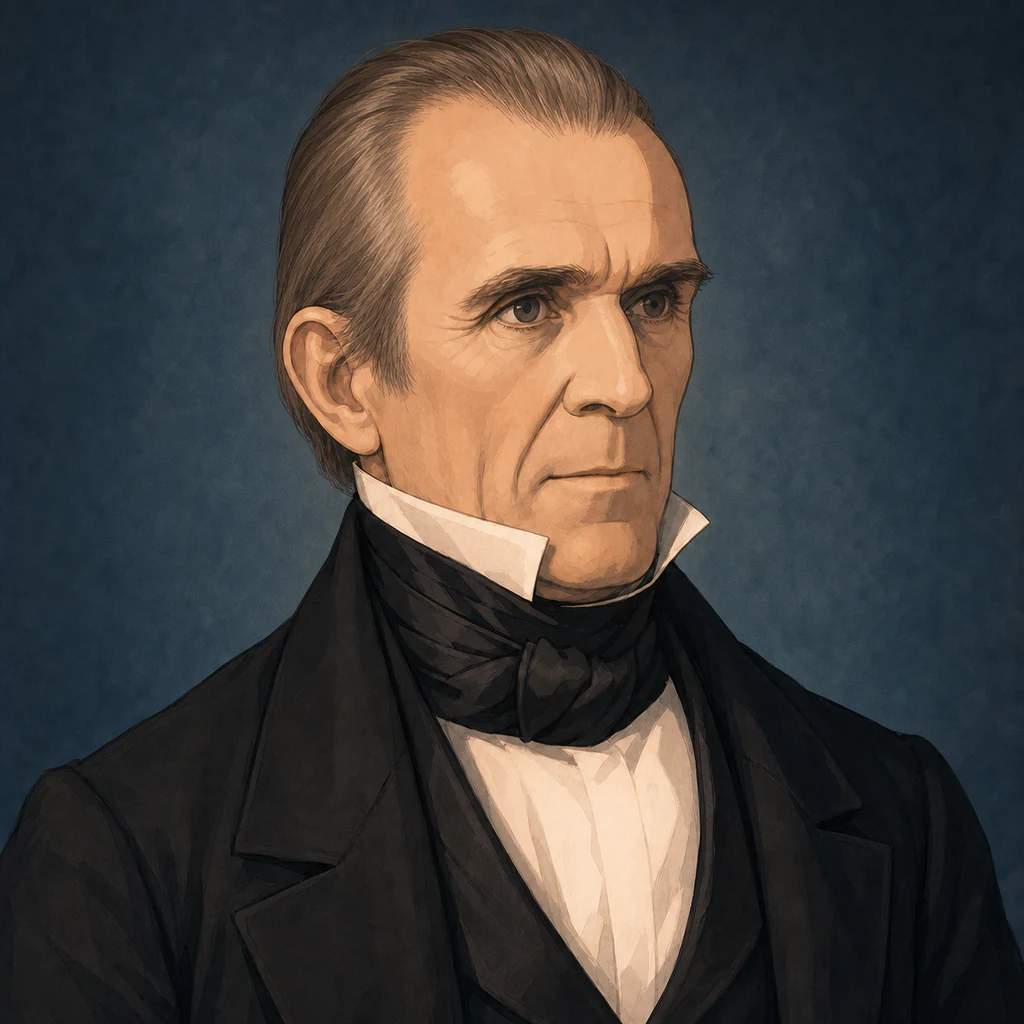
Biography for young readers
James K. Polk
Being the 11th President of the United States and helping the country grow in size
- Lived
- 1795-1849
- From
- American
- Reading time
- About 4 min
- Reading guide
- Independent-reader guide
Watch James K. Polk's story unfold
Why this story matters
A life worth remembering
Being the 11th President of the United States and helping the country grow in size
Think about it
What did you notice?
- Which moment changed the direction of this person's life?
- Which achievement or idea do you think mattered most?
- What is one question you would ask them?
Prefer to read? Open the complete biography transcript
A Student Steps Into Politics
James Knox Polk was born near Pineville, North Carolina, on November 2, 1795. His family moved to Tennessee in 1806, where farms and plantations—including his family’s—depended on enslaved labor. Often ill as a child, Polk began formal schooling later than many classmates, yet he graduated with honors from the University of North Carolina in 1818. He studied law, joined the Tennessee bar in 1820, and married Sarah Childress in 1824.
Polk entered the U.S. House of Representatives in 1825 as a loyal supporter of President Andrew Jackson. Colleagues called him “Young Hickory,” linking him to Jackson’s nickname, “Old Hickory.” Polk became Speaker of the House in 1835 and served until 1839, when he won election as governor of Tennessee. During his speakership, the House adopted a rule that blocked discussion of antislavery petitions, a reminder that his rise in politics was closely tied to the era’s defense of slavery.
The Surprise Candidate of 1844
After losing two later races for governor, Polk was not the best-known choice for president. At the Democratic convention in 1844, delegates could not agree on the leading candidates and selected him on the ninth ballot. This made him the nation’s first widely described “dark horse” presidential nominee: an unexpected contender who won. He defeated Whig candidate Henry Clay and became the eleventh president on March 4, 1845, at age 49.
Polk entered office with a short list of goals. His administration lowered tariffs, restored an independent federal treasury, and worked to settle western boundary questions. He also intended to serve only one term. His focused method helped him move legislation, but a checklist alone could not measure who benefited or who bore the costs of each decision.
Expansion, Diplomacy, and War
In 1846, the Oregon Treaty settled a long dispute with Great Britain by placing much of the boundary at the 49th parallel. That agreement avoided war and brought the present-day Pacific Northwest under U.S. control. The conflict with Mexico followed a different path. Polk supported the annexation of Texas and ordered American troops into land between the Nueces River and Rio Grande that both nations claimed. After fighting began there, he asked Congress for a declaration of war in May 1846.
The U.S.-Mexican War ended with the 1848 Treaty of Guadalupe Hidalgo. Mexico recognized Texas as part of the United States and ceded about 525,000 square miles in return for $15 million and other financial terms. The transfer reshaped both countries, cost many lives, displaced and changed life for people already living across the region, and sharpened the explosive debate over whether slavery would spread west. Polk was himself a slaveholder who supported slavery’s expansion.
A Short Retirement and a Complicated Legacy
Polk left office in March 1849 after one term. He and Sarah returned to Tennessee, but he became ill during their journey and died in Nashville on June 15, only 103 days after leaving the presidency. He was 53. During his White House years he kept a remarkably detailed diary; its 25 volumes and nearly 4,000 pages now help historians study his choices and daily work.
Polk achieved most of the goals he announced, and the United States stretched to the Pacific during his presidency. Yet those results cannot be separated from war, Mexican land loss, slavery, and the struggle over new western territories. His wider contribution is therefore a lesson in examining leadership from more than one angle: plans and persistence matter, but so do the methods used and the consequences carried by other people.
Did you know?
Fun facts about James K. Polk
-
James K. Polk graduated from the University of North Carolina in 1818.
-
Polk is the only Speaker of the U.S. House of Representatives to later serve as president.
-
News from the 1844 convention that nominated Polk traveled from Baltimore to Washington by telegraph.
-
Polk’s 1845 inauguration was the first presidential inauguration reported by telegraph.
-
His presidential diary fills 25 volumes and nearly 4,000 pages.
Learn & remember
Make the story yours
4 min read · Independent-reader guide
Three things to remember
- Known for: Being the 11th President of the United States and helping the country grow in size
- Lived: 1795-1849
- From: American
Quick check
What do you remember?
Think of an answer, then open each card to check.
What is James K. Polk best known for?
Being the 11th President of the United States and helping the country grow in size
When did James K. Polk live?
1795-1849
What place or nationality is connected to this story?
American
Biography
Zachary Taylor
Being the 12th President of the United States and a respected military leader
Biography
James Monroe
Being the fifth President of the United States and helping shape America’s place in the world.
Biography
James Buchanan
Being the 15th President of the United States
Biography
William Henry Harrison
Being the 9th President of the United States and a hero from the War of 1812
Biography
Benjamin Harrison
Being the 23rd President of the United States and helping modernize the country
Biography
Franklin Pierce
The 14th President of the United States who led the country during a challenging time before the Civil War
One story at a time
Who will you discover next?
Explore inspiring lives across science, art, history, music, and more.