
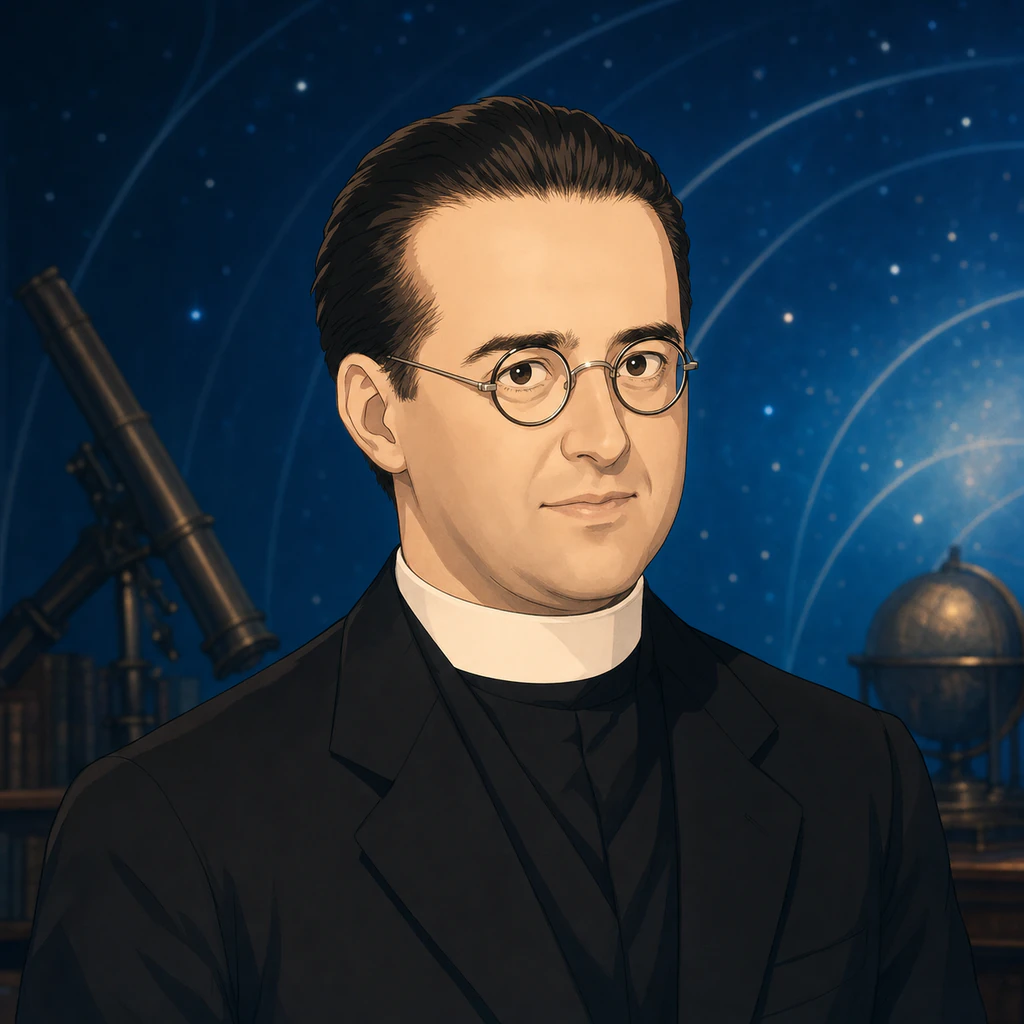
Biography for young readers
Georges Lemaître
He helped explain that the universe is expanding and began with the Big Bang.
- Lived
- 1894–1966
- From
- Belgian
- Reading time
- About 3 min
- Reading guide
- Advanced vocabulary
Watch Georges Lemaître's story unfold
Why this story matters
A life worth remembering
He helped explain that the universe is expanding and began with the Big Bang.
Think about it
What did you notice?
- Which moment changed the direction of this person's life?
- Which achievement or idea do you think mattered most?
- What is one question you would ask them?
Prefer to read? Open the complete biography transcript
From Engineering Student to Wartime Soldier
Before Georges Lemaître changed how scientists picture the universe, he was a Belgian teenager preparing to become an engineer. He was born in Charleroi on July 17, 1894, entered the Catholic University of Louvain at 17, and began engineering studies. When World War I reached Belgium in 1914, he interrupted school and volunteered for the Belgian army; after the war, he chose mathematics and physics instead of returning to engineering.
Lemaître completed a doctorate in mathematics in 1920, then entered a seminary and was ordained a Catholic priest in 1923. His religious vocation and scientific work were both important to him, but he later insisted that questions of faith and testable questions about nature should not be confused.
Learning Across the Atlantic
A Belgian fellowship took Lemaître to the University of Cambridge in 1923, where astronomer Arthur Eddington introduced him to modern stellar astronomy and numerical methods. The next year, he studied observations at Harvard College Observatory and enrolled in a physics doctorate at the Massachusetts Institute of Technology.
Lemaître returned to Louvain as a lecturer in 1925 while finishing his research, and he earned his MIT doctorate in 1927. That same year, the university made him a full professor, giving him a place to teach relativity, mechanics, astronomy, and mathematical methods while developing his boldest ideas.
An Expanding Universe and a Beginning
In a 1927 paper, Lemaître used Albert Einstein's equations together with observations of distant galaxies to argue that the universe is expanding. Alexander Friedmann had earlier found mathematical models of an expanding universe, but Lemaître independently connected such a model with astronomical measurements and calculated a relationship between a galaxy's distance and its apparent motion—the relationship now called the Hubble–Lemaître law.
Einstein initially objected to Lemaître's physical conclusion, while later observations helped the expanding-universe model gain attention. In 1931, Lemaître reasoned backward from the expansion to a far denser past and described the universe's beginning with the image of a “primeval atom.”
The name “Big Bang” came later, and the modern theory does not describe an ordinary explosion at one spot in empty space; it describes space itself expanding from an extremely hot, dense early state. This careful distinction shows how later evidence and many scientists' work developed Lemaître's first proposal into today's cosmology.
Recognition and a Wider Legacy
Belgium's Francqui Foundation awarded Lemaître its 1934 prize for the originality and influence of his research. He continued teaching and studying subjects including cosmic rays and computation, and from 1960 until his death he served as president of the Pontifical Academy of Sciences.
The discovery of cosmic microwave background radiation in 1964 gave strong support to a hot early universe. Lemaître learned about that evidence near the end of his life and died in Louvain on June 20, 1966.
Lemaître's wider contribution was a new way to ask about cosmic history: combine mathematics with observations, accept correction, and separate a scientific model from claims it cannot test. Every modern study of how the universe grew from its early state continues a path he helped open.
Did you know?
Fun facts about Georges Lemaître
-
Georges Lemaître was both a Catholic priest and a professor of physics.
-
He interrupted engineering studies to volunteer in the Belgian army during World War I.
-
He studied with astronomer Arthur Eddington at Cambridge and earned an MIT doctorate in 1927.
-
Belgium's Francqui Foundation awarded him the 1934 Francqui Prize for his scientific research.
-
He served as president of the Pontifical Academy of Sciences from 1960 until 1966.
-
The term “Big Bang” became common years after Lemaître introduced his primeval-atom idea.
Learn & remember
Make the story yours
3 min read · Advanced vocabulary
Three things to remember
- Known for: He helped explain that the universe is expanding and began with the Big Bang.
- Lived: 1894–1966
- From: Belgian
Words to know
Open a word for a short explanation.
astronomy
The scientific study of space, stars, planets, and the universe.
evidence
Information used to support or test an idea.
relativity
Einstein’s explanation of how space, time, motion, and gravity are connected.
theory
A well-supported explanation that connects evidence and observations.
Quick check
What do you remember?
Think of an answer, then open each card to check.
What is Georges Lemaître best known for?
He helped explain that the universe is expanding and began with the Big Bang.
When did Georges Lemaître live?
1894–1966
What place or nationality is connected to this story?
Belgian
Biography
Edwin Hubble
Discovering that the universe is much bigger than we thought and that it is expanding.
Biography
Georges Cuvier
Helping to start the science of paleontology and showing that some animals from the past became extinct.
Biography
Galileo Galilei
Helping people understand the sky by improving the telescope and studying space.
Biography
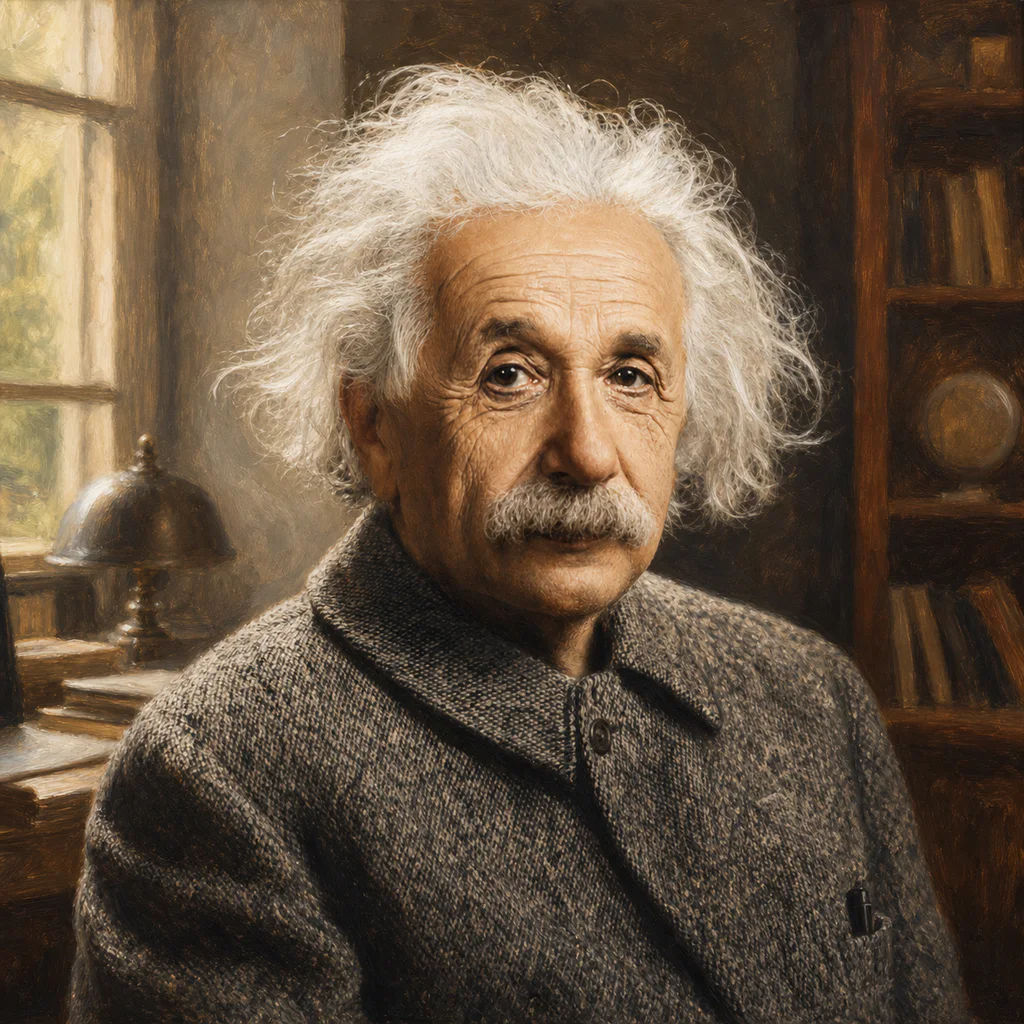
Albert Einstein
He was a brilliant scientist who helped us understand space, time, and light.
Biography
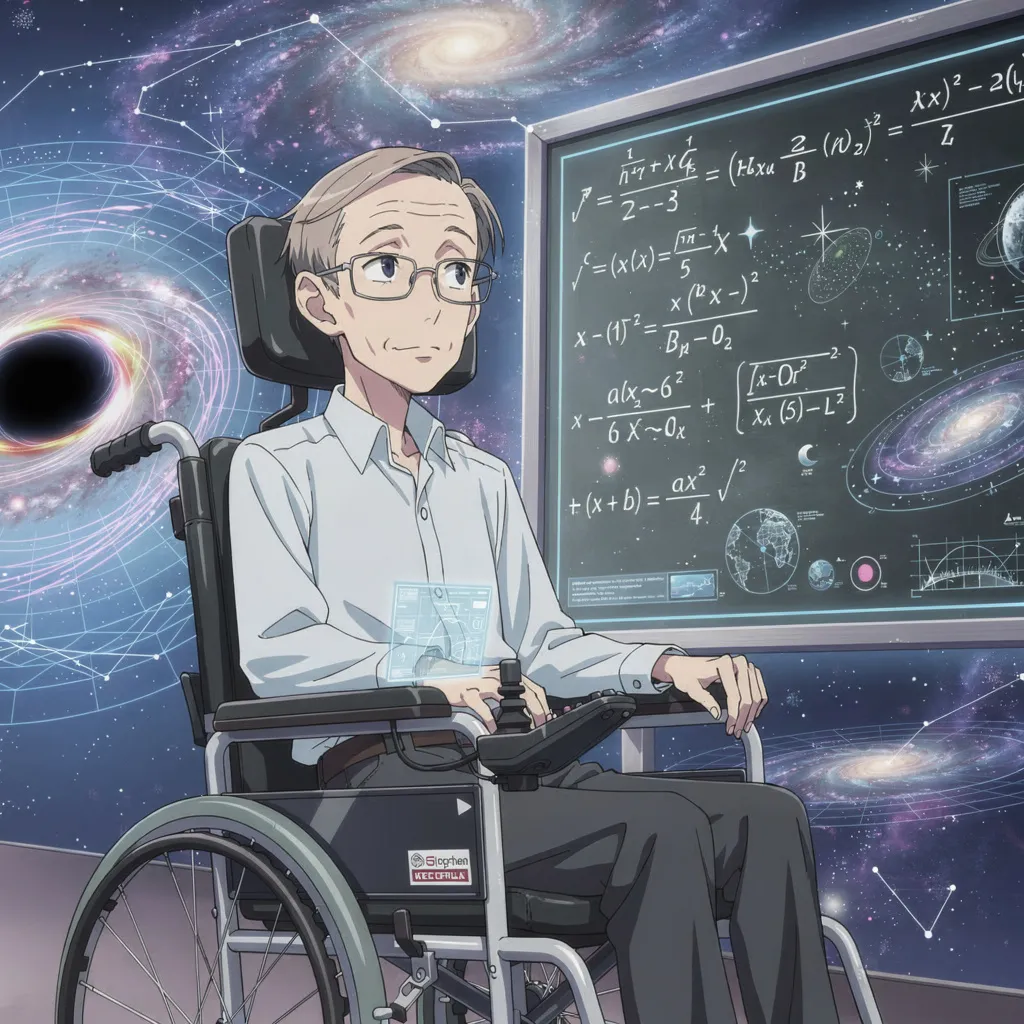
Stephen Hawking
A famous scientist who studied space, black holes, and helped people understand the universe.

Biography
Carl Sagan
Helping people understand space and science through books, TV shows, and exciting ideas.
One story at a time
Who will you discover next?
Explore inspiring lives across science, art, history, music, and more.