
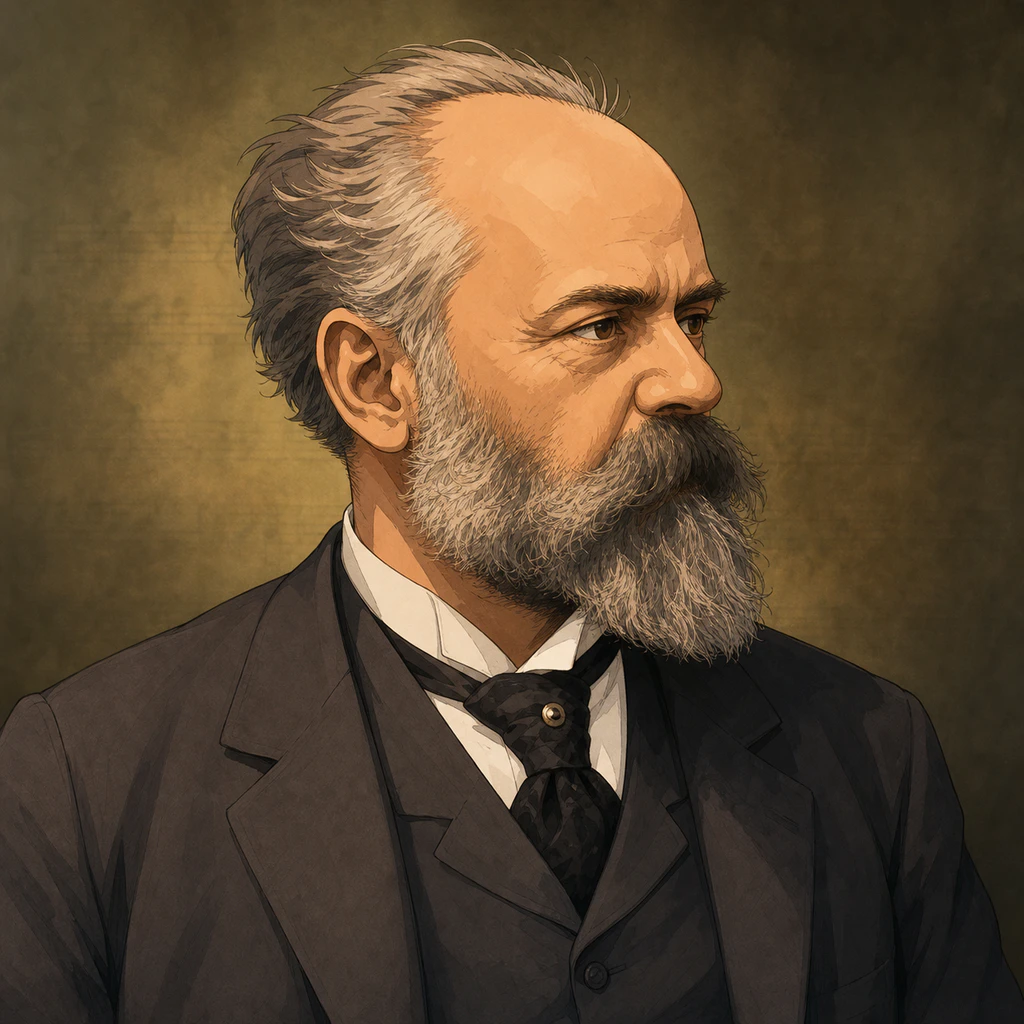
Biography for young readers
Antonín Dvořák
A famous composer who wrote beautiful music inspired by folk songs and different cultures
- Lived
- 1841-1904
- From
- Czech
- Reading time
- About 4 min
- Reading guide
- Independent-reader guide
Watch Antonín Dvořák's story unfold
Why this story matters
A life worth remembering
A famous composer who wrote beautiful music inspired by folk songs and different cultures
Think about it
What did you notice?
- Which moment changed the direction of this person's life?
- Which achievement or idea do you think mattered most?
- What is one question you would ask them?
Prefer to read? Open the complete biography transcript
A Violin in a Riverside Village
Before Antonín Dvořák wrote music heard around the world, he was a village boy playing violin for neighbors. He was born on September 8, 1841, in Nelahozeves, a Bohemian village in the Austrian Empire, now part of the Czech Republic. His father ran an inn and butcher's shop and also enjoyed making music. Antonín began learning violin at about six and sometimes played with local musicians. He also became fascinated by the new railway passing his village.
At 12, Dvořák went to Zlonice, where teacher Antonín Liehmann helped him study violin, piano, organ, and music theory. In 1857, the 16-year-old moved to Prague to attend organ school. He graduated in 1859, but composing did not immediately pay the bills. He played viola in dance bands and then in Prague's Provisional Theatre orchestra, learning from the music around him while writing his own works.
A Composer Finds His Audience
Dvořák's public breakthrough came in 1873 with a choral work called The Heirs of the White Mountain. He married Anna Čermáková that year. Money remained tight, so he applied for a government scholarship for artists. In 1877, composer Johannes Brahms, one of the judges, admired Dvořák's Moravian Duets and recommended them to publisher Fritz Simrock. The partnership helped Dvořák's music reach listeners far beyond Prague.
The lively Slavonic Dances became an international success. Dvořák usually created original melodies shaped by the rhythms and musical character he knew from Bohemia and other Slavic regions, rather than simply copying folk songs. His family also endured terrible loss: three young children died between 1875 and 1877. The deeply felt Stabat Mater later brought him major acclaim in England. He made nine trips there and received an honorary doctorate from Cambridge University in 1891.
Listening in the United States
In 1892, Dvořák crossed the Atlantic to direct New York's National Conservatory of Music. The school admitted women and Black students and offered scholarships to students with little money. Dvořák argued that American concert music should take African American spirituals and Native musical traditions seriously. Black composer and singer Harry Burleigh, a conservatory student, sang spirituals for him. Those traditions came from communities that had often been denied power, and scholars still discuss exactly how Dvořák transformed the sounds he heard.
His Symphony No. 9, From the New World, premiered at Carnegie Hall on December 16, 1893, with the New York Philharmonic. During a summer in Spillville, Iowa, he also wrote the American String Quartet. The music did not copy one place; it joined memories of Bohemia with Dvořák's experience of the United States.
Home Again, with a Wider Musical World
Dvořák returned home in 1895 and resumed teaching at the Prague Conservatory, becoming its director in 1901. He conducted the Czech Philharmonic's first concert in 1896. In his later years he concentrated on tone poems and operas, including Rusalka, first performed in 1901. He died in Prague on May 1, 1904.
Across more than 200 works, Dvořák wrote symphonies, chamber music, songs, choral pieces, and operas. He showed that a composer could build large classical forms while drawing energy from the musical character of particular communities. His American years also opened an important, still-unfinished conversation about whose music is heard, how traditions travel, and how listening across cultures requires both curiosity and care.
Did you know?
Fun facts about Antonín Dvořák
-
Dvořák began learning the violin at about six years old and played with local musicians near his family's inn.
-
He loved trains and watched the railway that passed through his home village.
-
Dvořák made nine trips to England to conduct and share his music.
-
The New York Philharmonic premiered his From the New World Symphony at Carnegie Hall in 1893.
-
He composed more than 200 works, including symphonies, chamber music, choral works, and operas.
Learn & remember
Make the story yours
4 min read · Independent-reader guide
Three things to remember
- Known for: A famous composer who wrote beautiful music inspired by folk songs and different cultures
- Lived: 1841-1904
- From: Czech
Words to know
Open a word for a short explanation.
composer
A person who creates music.
empire
A group of lands or peoples ruled by one government or leader.
theory
A well-supported explanation that connects evidence and observations.
Quick check
What do you remember?
Think of an answer, then open each card to check.
What is Antonín Dvořák best known for?
A famous composer who wrote beautiful music inspired by folk songs and different cultures
When did Antonín Dvořák live?
1841-1904
What place or nationality is connected to this story?
Czech
Biography
Anton Bruckner
Writing powerful symphonies and beautiful church music
Biography
Gustav Mahler
A famous composer and conductor known for his powerful symphonies and emotional music
Biography
Joseph Haydn
Being a famous composer who helped shape classical music and the symphony.
Biography
Johannes Brahms
A famous composer who wrote beautiful classical music that is still played today
Biography
Johann Sebastian Bach
A famous composer who wrote beautiful music that people still enjoy today.
Biography
Franz Schubert
He was a famous composer who wrote beautiful songs and music that people still enjoy today.
One story at a time
Who will you discover next?
Explore inspiring lives across science, art, history, music, and more.