
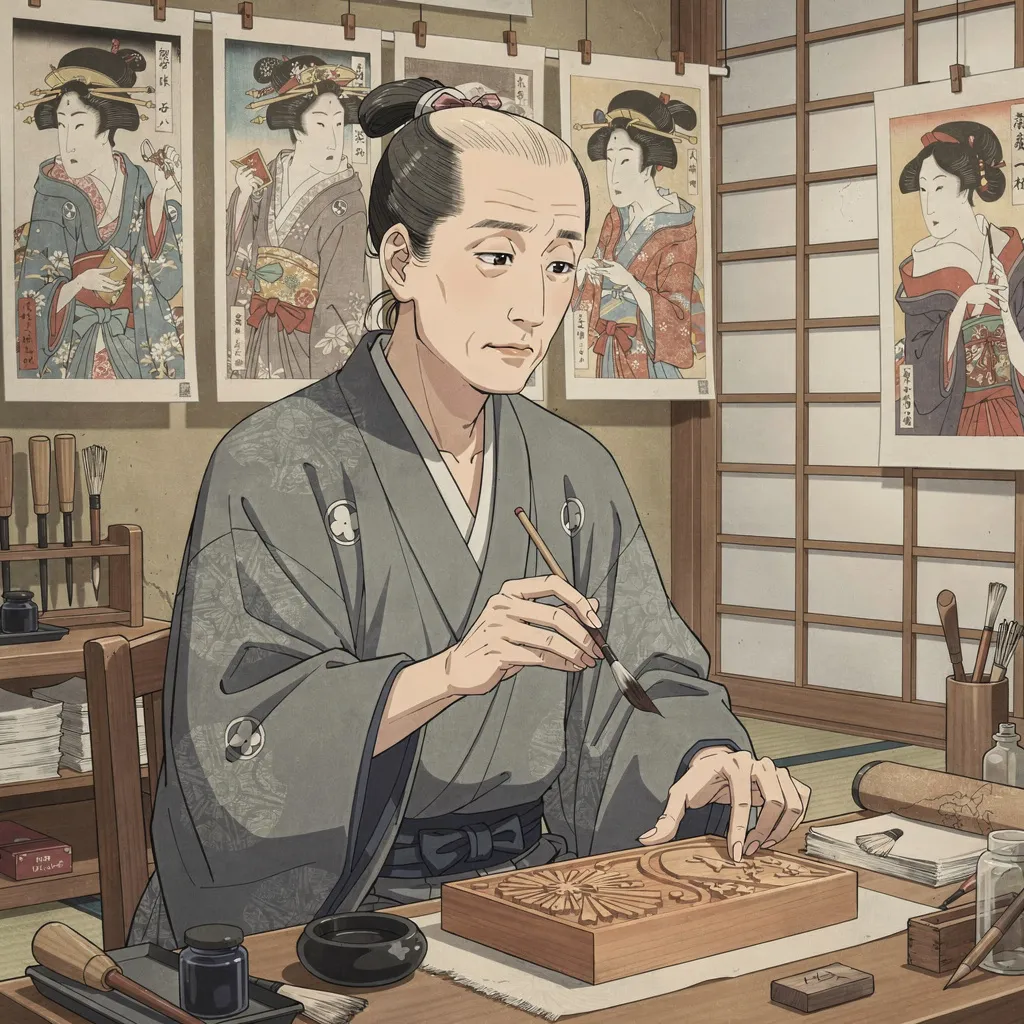
Creating beautiful ukiyo-e woodblock prints, especially portraits of women
Creating beautiful ukiyo-e woodblock prints, especially portraits of women
Kitagawa Utamaro was born in Japan around the year 1753. Not much is known about his childhood, but he grew up during a time when cities like Edo (now called Tokyo) were busy and full of culture.
As a young person, Utamaro showed a strong interest in art. He learned how to draw and paint by studying with other artists and by practicing every day. His hard work helped him become very skilled.
Utamaro became famous for making ukiyo-e, which are colorful woodblock prints. These prints were made by carving pictures into wood, adding ink, and pressing paper on top. Many copies could be made, so lots of people could enjoy the art.
Utamaro loved to create pictures of people, especially women. His portraits showed different emotions, hairstyles, and clothing styles. He paid close attention to faces and expressions, which made his work feel very real.
Utamaro is best known for his portraits of women, called bijin-ga, which means “pictures of beautiful people.” He helped change how people were shown in art by focusing on close-up views and gentle details.
His prints were very popular during his lifetime. People enjoyed seeing everyday life, fashion, and beauty captured in his art. Utamaro worked with publishers who helped share his prints all over Japan.
Later in life, Utamaro faced some difficulties and rules that limited what artists could create. Even so, he continued to make art and stayed true to his style.
Utamaro passed away in 1806, but his art did not fade away. Instead, it traveled far beyond Japan.
Today, Utamaro is remembered as one of the greatest ukiyo-e artists in history. His work inspired artists in Europe many years later and is still admired in museums around the world.
Utamaro’s art helps us learn about life in Japan long ago. His gentle and thoughtful pictures remind us to look closely at people and appreciate their unique beauty.
Utamaro often focused on faces and expressions instead of full bodies.
His prints were made using carved wooden blocks, one for each color.
Utamaro’s art became popular in Europe many years after he died.
Some of his prints show popular fashions and hairstyles of his time.
2 min read · Independent-reader guide
Think of an answer, then open each card to check.
Creating beautiful ukiyo-e woodblock prints, especially portraits of women
c.1753–1806
Japanese
A famous Japanese artist known for beautiful landscape woodblock prints.
A famous Japanese artist known for his beautiful woodblock prints, especially "The Great Wave off Kanagawa."
A famous Japanese samurai who became a wise teacher, artist, and writer.

Creating colorful art filled with dots, pumpkins, and amazing mirror rooms
Being the 'Father of Manga' and creating famous stories like Astro Boy.
A French painter who helped change art by leading the way toward modern painting.
Explore inspiring lives across science, art, history, music, and more.