
Biography for young readers
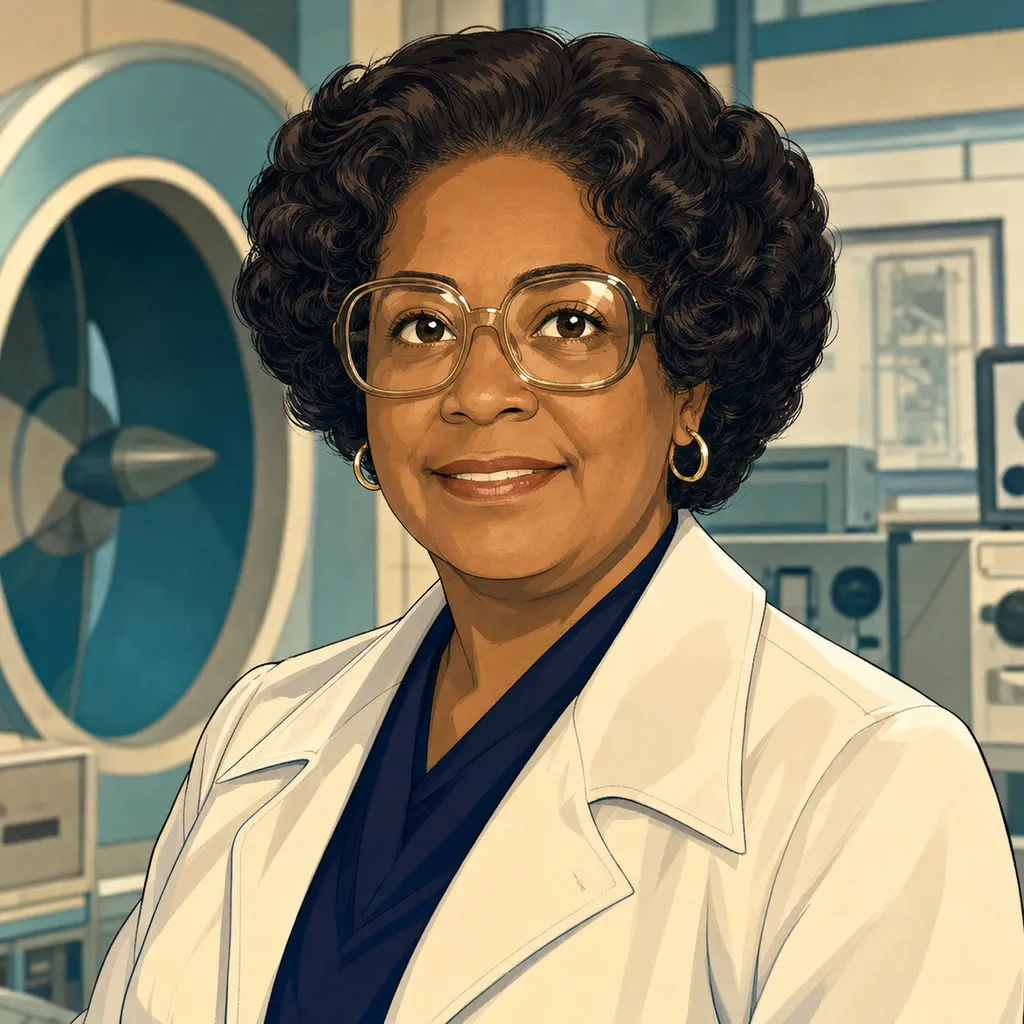
Mary Jackson
Being the first Black female engineer at NASA and helping make space travel safer
- Lived
- 1921-2005
- From
- American
- Reading time
- About 3 min
- Reading guide
- Independent-reader guide
Watch Mary Jackson's story unfold
Why this story matters
A life worth remembering
Being the first Black female engineer at NASA and helping make space travel safer
Think about it
What did you notice?
- Which moment changed the direction of this person's life?
- Which achievement or idea do you think mattered most?
- What is one question you would ask them?
Prefer to read? Open the complete biography transcript
Numbers, Science, and Service in Hampton
Before engineers could design better high-speed aircraft, they had to understand how air rushed around wings and other surfaces. Mary Winston Jackson helped solve those problems. She was born in Hampton, Virginia, on April 9, 1921, and graduated from high school with highest honors. At Hampton Institute, now Hampton University, she studied mathematics and physical science and earned a bachelor's degree in 1942.
Jackson's route to aeronautics was not direct. She taught mathematics at a Black school in Maryland, then worked in several Hampton-area jobs. In April 1951, she joined the National Advisory Committee for Aeronautics, or NACA, at Langley Memorial Aeronautical Laboratory. She began as a research mathematician, sometimes called a “human computer,” in the segregated West Area Computing unit led by Dorothy Vaughan. The separate workplace reflected Virginia's Jim Crow laws, not the quality of the women's work.
Learning in a Supersonic Wind Tunnel
After two years, engineer Kazimierz Czarnecki invited Jackson to work with him in Langley's 4-foot by 4-foot Supersonic Pressure Tunnel. The powerful tunnel could blast test models with air moving close to twice the speed of sound. Jackson learned to conduct experiments and analyze the measurements that the tunnel produced.
Czarnecki encouraged her to enter a training program for engineers. The program required graduate-level mathematics and physics classes offered after work by the University of Virginia. Those classes met at the all-white Hampton High School, so Jackson had to obtain special permission from the City of Hampton to attend. She completed the courses and qualified for a new kind of responsibility.
Becoming an Aerospace Engineer
Jackson earned her promotion to engineer in 1958, the same year NACA became NASA. She is remembered as NASA's first Black woman engineer. That September, she and Czarnecki published a technical report called Effects of Nose Angle and Mach Number on Transition on Cones at Supersonic Speeds. Their experiments examined when the thin layer of air flowing over a cone changed from smooth to turbulent.
For nearly two decades, Jackson worked as an engineer and authored or co-authored about a dozen research reports. Much of her research explored airflow around aircraft, using evidence from wind tunnels and flight experiments. Her work required careful observation, exact mathematics, and clear explanations that other engineers could test.
Making More Room for Others
By the late 1970s, Jackson saw that women at Langley still faced barriers to promotion. In 1979, she left engineering and accepted a lower-grade position as Langley's Federal Women's Program Manager. In that role, she helped women and other employees understand the education and career steps that could open new opportunities. She retired from NASA in 1985 after 34 years at Langley.
Jackson also brought science into her community. She helped young people at Hampton's King Street Community Center build a working wind tunnel, and she served as a Girl Scout leader for more than 30 years. She died on February 11, 2005. In 2021, NASA formally named its Washington headquarters building for her. Jackson's wider contribution joins two kinds of engineering: studying how air moves and helping institutions remove barriers so more people can move forward.
Did you know?
Fun facts about Mary Jackson
-
Mary Jackson earned a bachelor's degree in both mathematics and physical science from Hampton Institute in 1942.
-
Her 1958 technical report studied how airflow changed over cones at supersonic speeds.
-
She authored or co-authored about a dozen aeronautics research reports during her engineering career.
-
Jackson helped children at a Hampton community center build and test their own wind tunnel.
-
NASA formally named its Washington headquarters building for Mary W. Jackson in 2021.
Learn & remember
Make the story yours
3 min read · Independent-reader guide
Three things to remember
- Known for: Being the first Black female engineer at NASA and helping make space travel safer
- Lived: 1921-2005
- From: American
Words to know
Open a word for a short explanation.
evidence
Information used to support or test an idea.
Quick check
What do you remember?
Think of an answer, then open each card to check.
What is Mary Jackson best known for?
Being the first Black female engineer at NASA and helping make space travel safer
When did Mary Jackson live?
1921-2005
What place or nationality is connected to this story?
American
Biography
Katherine Johnson
Helping NASA send astronauts safely into space using her amazing math skills
Biography
Dorothy Vaughan
Being a brilliant mathematician who helped NASA succeed and became the first African American supervisor at NACA, NASA’s predecessor.
Biography
Sally Ride
She was the first American woman to travel into space.
Biography
John Glenn
Being the first American to orbit Earth and a lifelong explorer of space and public service
Biography
Mary Earps
Being a world-class goalkeeper who helped England’s Lionesses win major football trophies
Biography
Buzz Aldrin
Being one of the first astronauts to walk on the Moon during the Apollo 11 mission.
One story at a time
Who will you discover next?
Explore inspiring lives across science, art, history, music, and more.