
Biography for young readers
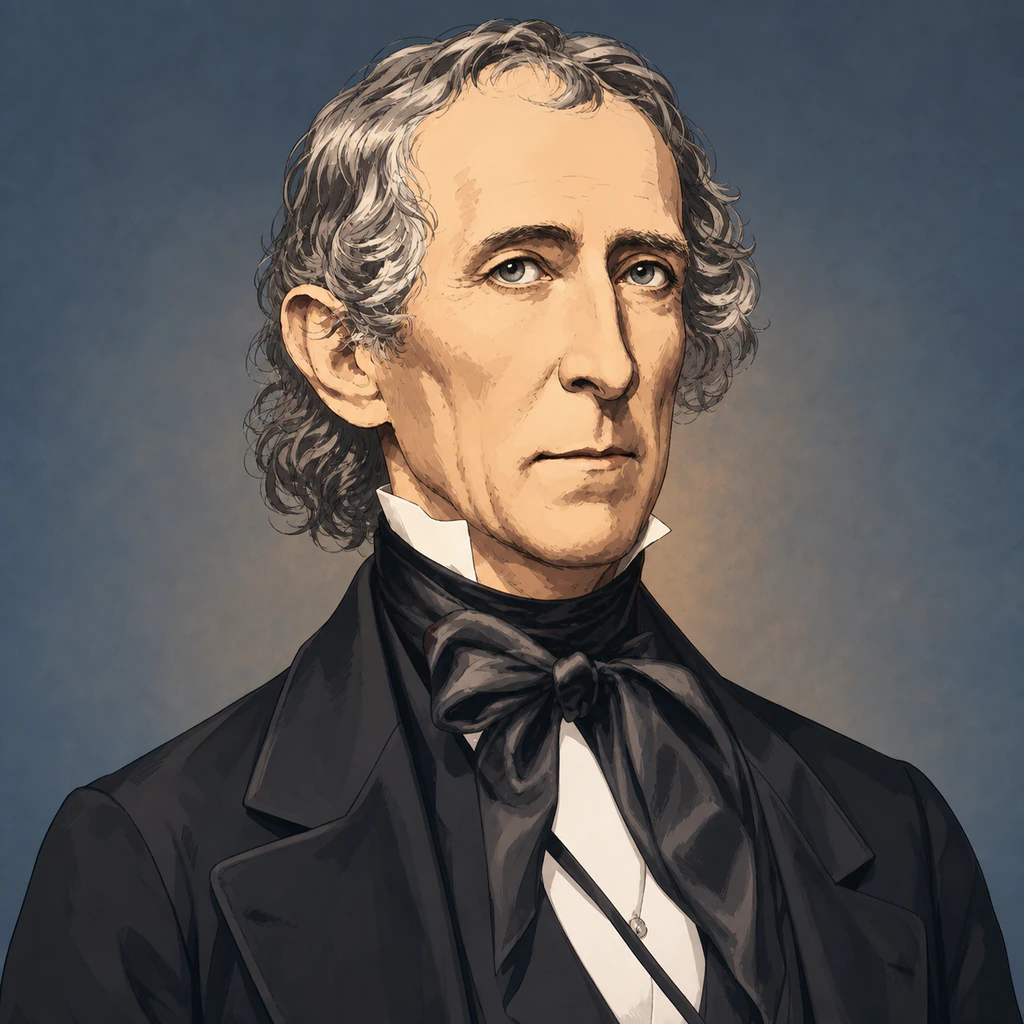
John Tyler
Becoming the first Vice President to take over as President of the United States
- Lived
- 1790–1862
- From
- American
- Reading time
- About 4 min
- Reading guide
- Independent-reader guide
Watch John Tyler's story unfold
Why this story matters
A life worth remembering
Becoming the first Vice President to take over as President of the United States
Think about it
What did you notice?
- Which moment changed the direction of this person's life?
- Which achievement or idea do you think mattered most?
- What is one question you would ask them?
Prefer to read? Open the complete biography transcript
Growing Up in Virginia
John Tyler entered history because he faced a question no American leader had answered before: what should happen when a president dies in office? His answer came after a long political career. Tyler was born on March 29, 1790, at Greenway, his family's plantation in Charles City County, Virginia. His father was a planter, judge, and later governor. The family's wealth depended in part on the labor of enslaved people, a system Tyler would continue to support throughout his life.
At 12, Tyler entered the preparatory branch of the College of William & Mary. He moved into its college program three years later, graduated in 1807, and studied law. He joined the Virginia bar in 1809. This education prepared him for public office, but the rights and opportunities he enjoyed were not shared by the people held in slavery on his family's land.
From State Office to the National Stage
Tyler won election to the Virginia House of Delegates in 1811, when he was 21. He later served in the U.S. House of Representatives, became governor of Virginia in 1825, and entered the U.S. Senate in 1827. He argued for states' rights and limited federal power. In practice, those views often defended the political strength of slaveholding states.
Tyler began as a Democrat but broke with President Andrew Jackson and joined the Whig Party. In 1840, the Whigs chose him as William Henry Harrison's running mate, partly to attract Southern voters. Their campaign slogan was “Tippecanoe and Tyler Too.” Harrison and Tyler won, and Tyler became vice president on March 4, 1841.
The First Unexpected Succession
President Harrison died on April 4, only one month after taking office. The Constitution did not clearly say whether Tyler became the president or merely performed the president's duties. Tyler insisted that he held the full office. He took the presidential oath on April 6 and acted as the nation's tenth president, not as an “acting president.” Congress eventually accepted his position, creating a precedent followed after later presidential deaths. The Twenty-Fifth Amendment made this rule explicit in 1967.
Tyler soon clashed with the Whig leaders who had helped elect him. He vetoed bills to create a new national bank, most of Harrison's cabinet resigned, and the Whigs expelled him from the party. His administration still completed the Webster-Ashburton Treaty in 1842, settling parts of the boundary between the United States and British North America.
Expansion, Division, and a Mixed Legacy
Near the end of his term, Tyler pushed to annex the Republic of Texas. A treaty failed in the Senate, so Congress used a joint resolution instead. Tyler signed it on March 1, 1845, three days before leaving office; Texas entered the United States later that year. Annexation expanded the country, but it also widened the struggle over slavery and worsened tensions with Mexico that led to war under President James K. Polk.
Tyler returned to Virginia. When the nation split in 1861, he supported Virginia's secession and won election to the Confederate House of Representatives. He died on January 18, 1862, before taking that seat. Tyler's wider legacy must hold two truths together: his firm claim to the presidency gave the country a durable succession rule, while his defense of slavery, expansion, and secession helped deepen injustices and divisions that led toward the Civil War.
Did you know?
Fun facts about John Tyler
-
John Tyler entered the preparatory branch of William & Mary at age 12 and graduated from the college at 17.
-
He served as vice president for only about one month before President William Henry Harrison died.
-
Tyler was the first vice president to claim the full presidency after a president died in office.
-
He had 15 children, more than any other U.S. president.
-
The Webster-Ashburton Treaty signed during his presidency helped settle the northeastern boundary between the United States and British North America.
Learn & remember
Make the story yours
4 min read · Independent-reader guide
Three things to remember
- Known for: Becoming the first Vice President to take over as President of the United States
- Lived: 1790–1862
- From: American
Quick check
What do you remember?
Think of an answer, then open each card to check.
What is John Tyler best known for?
Becoming the first Vice President to take over as President of the United States
When did John Tyler live?
1790–1862
What place or nationality is connected to this story?
American
Biography
George Washington
Being the first President of the United States and helping start a new country
Biography
Zachary Taylor
Being the 12th President of the United States and a respected military leader
Biography
Andrew Johnson
Being the 17th President of the United States and leading the country during a very challenging time after the Civil War
Biography
John Quincy Adams
He was the 6th President of the United States and a talented diplomat who helped shape America’s role in the world.
Biography
John Adams
Being the second President of the United States and a leader in America’s fight for independence
Biography
Andrew Jackson
Being the seventh President of the United States and a strong, determined leader.
One story at a time
Who will you discover next?
Explore inspiring lives across science, art, history, music, and more.