
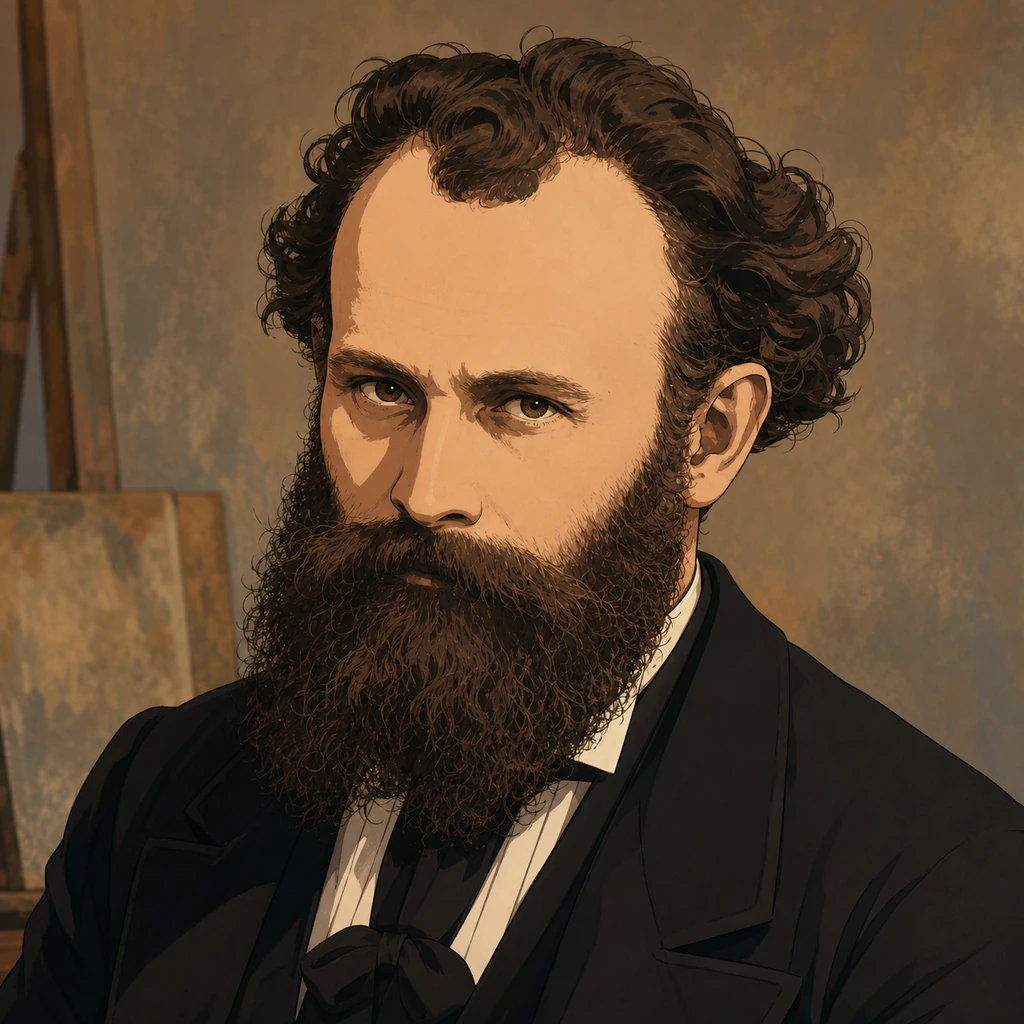
Biography for young readers
Édouard Manet
A French painter who helped change art by leading the way toward modern painting.
- Lived
- 1832-1883
- From
- French
- Reading time
- About 3 min
- Reading guide
- Independent-reader guide
Watch Édouard Manet's story unfold
Why this story matters
A life worth remembering
A French painter who helped change art by leading the way toward modern painting.
Think about it
What did you notice?
- Which moment changed the direction of this person's life?
- Which achievement or idea do you think mattered most?
- What is one question you would ask them?
Prefer to read? Open the complete biography transcript
Choosing Art Over the Navy
Édouard Manet helped make the streets, gardens, and cafés of his own time feel important enough for large museum paintings. He was born in Paris on January 23, 1832, into a prosperous family. His father worked in France’s Ministry of Justice and expected him to choose a conventional profession, while a supportive uncle encouraged his drawing.
As a teenager, Manet hoped to become a naval officer, but he twice failed the entrance examination for France’s Naval College. In 1850 he entered painter Thomas Couture’s studio instead. For about six years he practiced drawing figures, copied old master paintings at the Louvre, and studied art during trips in Europe. He especially admired the strong contrasts and direct brushwork of Spanish painters such as Diego Velázquez.
Challenging the Salon
The official Paris Salon could make an artist’s reputation. Manet’s The Spanish Singer earned an honorable mention there in 1861, but later paintings met resistance. Instead of carefully hiding every brushstroke, he placed clear areas of light and dark beside one another. He also gave the scale of history paintings to recognizable people and places from modern Paris.
In 1863 the Salon jury rejected Luncheon on the Grass, and it appeared at the alternative Salon des Refusés. Viewers argued about its plainly modern picnic scene and its use of an adult nude figure without a mythological story. When Olympia reached the Salon in 1865, its direct gaze and modern setting caused another fierce response. The paintings were not quick snapshots: Manet planned them through drawings, models, and studio work while deliberately testing old artistic rules.
Painting Modern Paris
Criticism did not separate Manet from other artists. He exchanged ideas with Edgar Degas, Berthe Morisot, Claude Monet, and writers including Charles Baudelaire and Émile Zola. His pictures recorded concert gardens, railways, cafés, workers, and crowded entertainment halls. In 1874 he painted near Monet and Auguste Renoir at Argenteuil, where brighter outdoor light entered his palette.
Friends invited Manet to join the independent exhibitions that became known as Impressionist shows. He declined every time because he still wanted recognition from the Salon. That choice is why he is often described as a bridge rather than simply an Impressionist: younger painters learned from his modern subjects and bold surfaces, while he also learned from their brighter colors and outdoor experiments.
A Final Masterpiece and a Wider Legacy
Manet’s health worsened in his last years, yet he continued to paint. His 1882 A Bar at the Folies-Bergère became his last major canvas. It centers on a working barmaid named Suzon, whom he painted in his studio after sketching at the Paris music hall. Bottles, flowers, electric lights, a busy reflected crowd, and a purposely shifted mirror image turn one workplace into a puzzle about modern city life.
Manet died in Paris in April 1883 at age 51. During his lifetime, viewers often treated his work as unfinished or shocking. Later artists and historians saw how carefully he had joined old compositions to the people, technology, and public spaces around him. His wider contribution was to show that modern life—ordinary, complicated, and sometimes uncomfortable—could carry the weight of serious art.
Did you know?
Fun facts about Édouard Manet
-
Manet entered Thomas Couture’s art studio in 1850 after twice missing admission to France’s Naval College.
-
The Spanish Singer earned Manet an honorable mention at the Paris Salon in 1861.
-
Although he was close to several Impressionists, Manet never exhibited in any of their independent group shows.
-
Manet painted the barmaid Suzon in his studio when creating A Bar at the Folies-Bergère.
-
A Bar at the Folies-Bergère includes electric lights, a strikingly modern detail for a painting completed in 1882.
Learn & remember
Make the story yours
3 min read · Independent-reader guide
Three things to remember
- Known for: A French painter who helped change art by leading the way toward modern painting.
- Lived: 1832-1883
- From: French
Quick check
What do you remember?
Think of an answer, then open each card to check.
What is Édouard Manet best known for?
A French painter who helped change art by leading the way toward modern painting.
When did Édouard Manet live?
1832-1883
What place or nationality is connected to this story?
French

Biography
Claude Monet
A famous painter who helped start Impressionism by showing light and color in new ways.
Biography
Paul Cézanne
A famous painter who helped change art and inspire modern artists.
Biography
Edgar Degas
A famous artist known for his beautiful paintings and sculptures of dancers

Biography
Pierre-Auguste Renoir
A famous painter who helped create Impressionism and loved painting people and happy moments

Biography
Paul Gauguin
A Post-Impressionist painter known for colorful paintings and for helping shape modern art
Biography
Eugène Delacroix
A famous French painter who helped lead the Romantic art movement with bold colors and exciting scenes
One story at a time
Who will you discover next?
Explore inspiring lives across science, art, history, music, and more.