
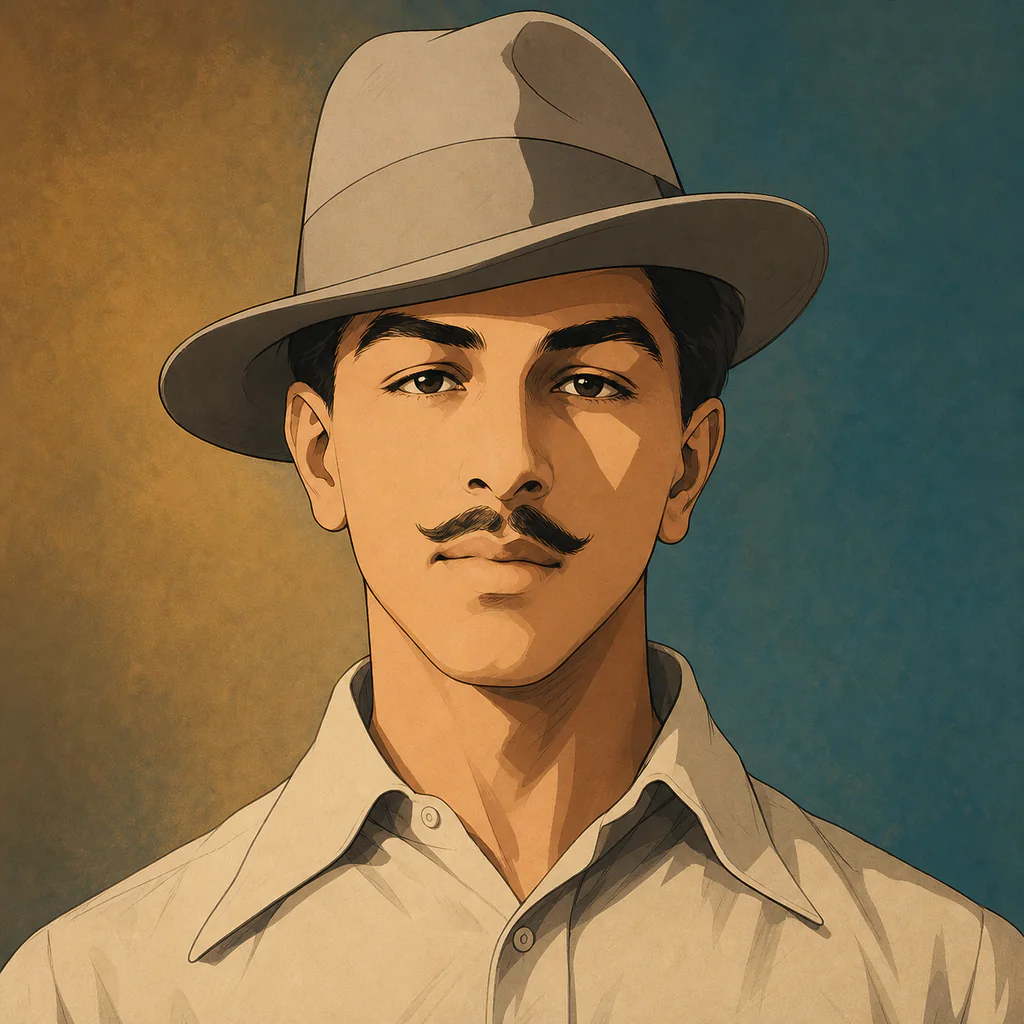
Biography for young readers
Bhagat Singh
Being a brave young leader who inspired India’s freedom movement with his courage and ideas
- Lived
- 1907-1931
- From
- Indian
- Reading time
- About 4 min
- Reading guide
- Independent-reader guide
Watch Bhagat Singh's story unfold
Why this story matters
A life worth remembering
Being a brave young leader who inspired India’s freedom movement with his courage and ideas
Think about it
What did you notice?
- Which moment changed the direction of this person's life?
- Which achievement or idea do you think mattered most?
- What is one question you would ask them?
Prefer to read? Open the complete biography transcript
A Reader in Colonial Punjab
Before Bhagat Singh became one of India's best-known young revolutionaries, he was a student who filled his days with books and debate. He was born in September 1907 in Banga, in Punjab under British rule, in an area that is now part of Pakistan. Several members of his family took part in movements against colonial rule, so political questions were part of his world from childhood.
Singh attended school in Lahore and then studied at National College, which had been created as an Indian alternative to British-supported institutions. He read history and political writing, acted in plays, and learned how newspapers could spread ideas. As a teenager, he began thinking not only about independence but also about the kind of fairer society that might follow it.
Choosing Revolutionary Politics
In 1926, Singh helped organize the Naujawan Bharat Sabha, a youth group that opposed British rule and tried to unite people across religious divisions. He later worked with the Hindustan Socialist Republican Association. Unlike Mahatma Gandhi, who led a mass movement based on nonviolence, Singh and his comrades believed revolutionary violence could challenge colonial power. Their different methods remain an important part of understanding India's independence struggle.
After police struck nationalist leader Lala Lajpat Rai during an October 1928 protest, Rai died in November. Singh and several comrades planned to kill police superintendent James Scott in revenge. On December 17, they mistakenly killed another officer, John Saunders. The shooting was a real and deadly act, not a legend or a movie scene, and it made Singh a wanted man.
The Assembly Protest and Hunger Strike
On April 8, 1929, Singh and Batukeshwar Dutt threw two bombs into the Central Legislative Assembly in Delhi to protest proposed colonial laws. The bombs were intended to make noise rather than kill, and no one died, although people were injured. The two men scattered leaflets, shouted a revolutionary slogan, stayed at the scene, and were arrested. They wanted the trial to draw attention to their political message.
In jail, Singh and other prisoners began a hunger strike over unequal food, clothing, reading materials, and treatment for Indian political prisoners. A statement by Jawaharlal Nehru from July 1929 recorded that Singh and Dutt had already gone without food for more than 20 days. The protest gained public attention. During imprisonment, Singh also kept reading and writing, explaining his views on freedom, religion, equality, and revolution.
A Short Life with a Long Legacy
British authorities connected Singh to the Saunders killing and tried him in the Lahore Conspiracy Case. He, Shivaram Rajguru, and Sukhdev Thapar were sentenced to death and executed in Lahore on March 23, 1931. Singh was only 23. His death made him a powerful symbol of resistance, but remembering him honestly means holding together his courage, his serious study, and the violence in which he took part.
Bhagat Singh's writings and famous 1929 portrait still shape how people discuss colonialism, protest, and justice. Admirers call him a martyr, while historians continue to debate how later groups have used his image and ideas. His wider contribution lies in the questions he forced into public view: who holds power, what freedom should include, and how young people can study society closely enough to imagine changing it.
Did you know?
Fun facts about Bhagat Singh
-
Bhagat Singh helped organize the Naujawan Bharat Sabha and became its secretary while still a teenager.
-
He worked at the Pratap newspaper press in Kanpur before returning to Lahore.
-
His 1929 Assembly protest was planned to attract attention; he and Batukeshwar Dutt stayed and were arrested.
-
Bhagat Singh continued reading and writing in jail, and collections of his political essays are still published.
-
The well-known photograph of him in a light-colored hat was taken in Delhi in April 1929, when he was 21.
Learn & remember
Make the story yours
4 min read · Independent-reader guide
Three things to remember
- Known for: Being a brave young leader who inspired India’s freedom movement with his courage and ideas
- Lived: 1907-1931
- From: Indian
Words to know
Open a word for a short explanation.
revolution
A major and often rapid change in government or society.
Quick check
What do you remember?
Think of an answer, then open each card to check.
What is Bhagat Singh best known for?
Being a brave young leader who inspired India’s freedom movement with his courage and ideas
When did Bhagat Singh live?
1907-1931
What place or nationality is connected to this story?
Indian
Biography
Subhas Chandra Bose
Being a brave leader who worked hard for India’s freedom from British rule
Biography
Mahatma Gandhi
Leading India to independence using peaceful protest and nonviolence
Biography
Rani of Jhansi (Lakshmibai)
A brave queen who became a symbol of courage and leadership in India during the 1857 uprising.
Biography
Rabindranath Tagore
A famous poet, writer, artist, and teacher who won the Nobel Prize in Literature.
Biography
Jawaharlal Nehru
He was the first Prime Minister of India and a leader who helped India become an independent nation.
Biography
Jean-Paul Sartre
A famous thinker and writer who shared big ideas about freedom and choice
One story at a time
Who will you discover next?
Explore inspiring lives across science, art, history, music, and more.