
Biography for young readers
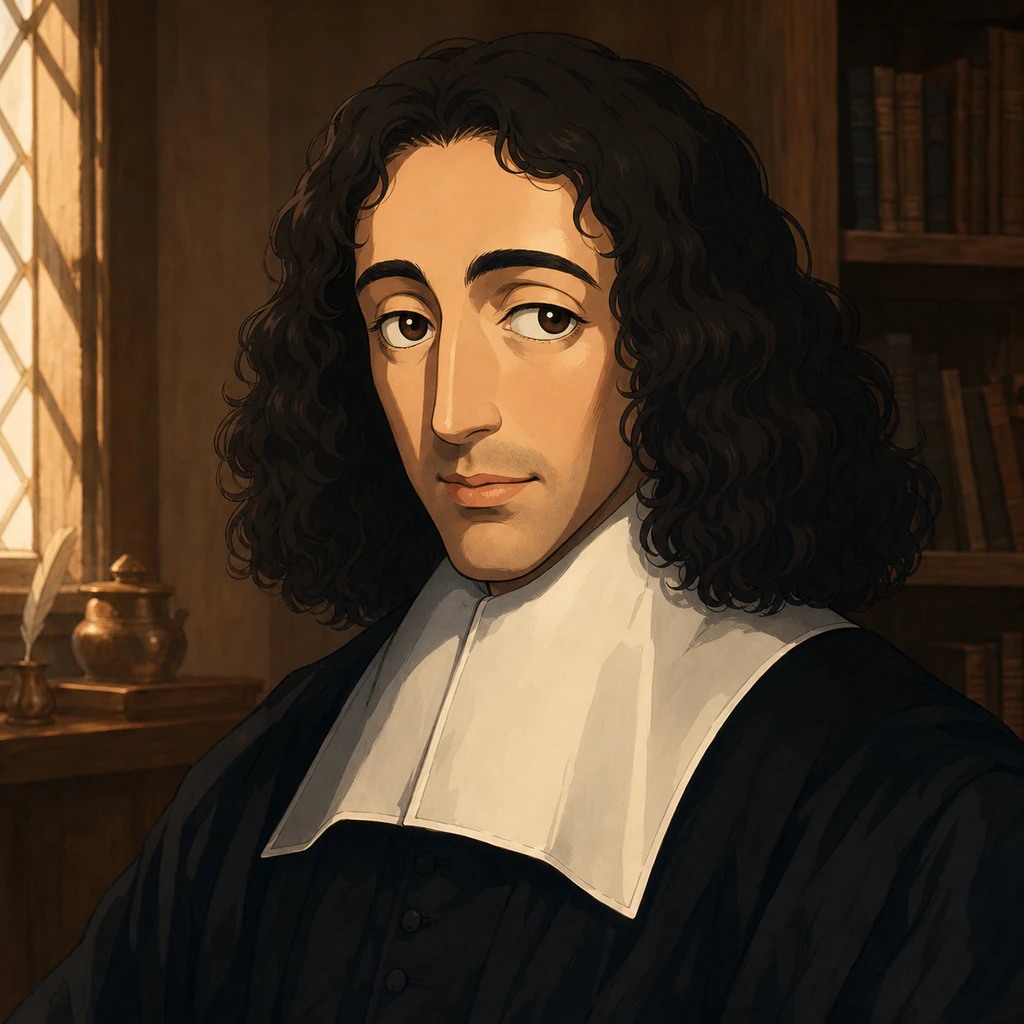
Baruch Spinoza
Sharing big ideas about thinking clearly, understanding nature, and living a good life
- Lived
- 1632–1677
- From
- Dutch
- Reading time
- About 4 min
- Reading guide
- Independent-reader guide
Watch Baruch Spinoza's story unfold
Why this story matters
A life worth remembering
Sharing big ideas about thinking clearly, understanding nature, and living a good life
Think about it
What did you notice?
- Which moment changed the direction of this person's life?
- Which achievement or idea do you think mattered most?
- What is one question you would ask them?
Prefer to read? Open the complete biography transcript
A Young Thinker in Amsterdam
Baruch Spinoza was born in Amsterdam on November 24, 1632, into the city's Portuguese-Jewish community. He was also known as Bento and, in Latin, Benedictus; all three names mean “blessed.” His family had roots in Portugal, where earlier generations of Jews had faced forced conversion and persecution. In Amsterdam, young Baruch studied Hebrew, the Bible, and Jewish commentaries at the community's Talmud Torah school.
At 17, he left formal schooling to help with his family's importing business. After his father died in 1654, he and his brother continued the firm. Then, on July 27, 1656, the congregation placed the 23-year-old under a formal ban called a herem. The surviving record does not fully explain the events behind it, so historians debate the exact path to the break. Spinoza's later writings did challenge accepted teachings about God, Scripture, and religious law.
Lenses and New Questions
By 1661, Spinoza was living in Rijnsburg, near Leiden. He supported himself partly by grinding and polishing lenses for optical instruments. This precise craft connected him with the scientific world: good lenses helped researchers see things that eyes alone could not. He also exchanged letters about philosophy and science with Henry Oldenburg, who later became the first secretary of the Royal Society in London.
Spinoza worked on early explanations of knowledge, nature, and human well-being. In 1663, he published Principles of Cartesian Philosophy, an account of René Descartes's ideas arranged like a series of proofs. It was the only book published under Spinoza's own name during his lifetime. He later lived in Voorburg and The Hague while developing a much larger system of his own.
Books That Challenged His Century
In 1670, Spinoza anonymously published the Theological-Political Treatise. It argued that readers should study Scripture in its historical setting and that freedom to think and speak can help a peaceful state. The book angered many religious and political authorities. Spinoza completed his greatest work, the Ethics, by 1675, but decided not to publish it while he was alive.
The Ethics looks unusual for a philosophy book. It moves through definitions, axioms, propositions, and demonstrations, following the pattern of geometry. Spinoza argued that God and Nature are not two separate realities and that human beings belong completely to nature. Because thoughts and emotions have causes, he believed people could become more active and freer by understanding those causes, testing ideas carefully, and learning how emotions shape choices.
A Short Life and a Long Conversation
Spinoza died in The Hague on February 21, 1677, at age 44, leaving a Political Treatise unfinished. Later that year, friends published a collection of his works, including the Ethics. That timing matters: the book for which he is best known reached readers only after he could no longer answer supporters or critics himself.
Spinoza's conclusions remain challenging, and scholars still disagree about how to interpret them. Yet his questions continue to travel: What does it mean to be part of nature? How can understanding an emotion change its power over us? Why does freedom of thought matter to a community? His wider contribution was to connect those enormous questions in one carefully argued system and invite later readers to examine even their most familiar beliefs.
Did you know?
Fun facts about Baruch Spinoza
-
Baruch, Bento, and Benedictus are three forms of Spinoza's name, and all mean “blessed.”
-
The only book published under Spinoza's own name during his lifetime was Principles of Cartesian Philosophy in 1663.
-
Museum Het Spinozahuis preserves an old wooden lens-grinding tool that Spinoza used for scientific work.
-
Spinoza arranged the Ethics with definitions, axioms, propositions, and demonstrations, much like a geometry text.
-
The Theological-Political Treatise appeared anonymously in 1670.
-
Spinoza's friends published the Ethics after his death in 1677.
Learn & remember
Make the story yours
4 min read · Independent-reader guide
Three things to remember
- Known for: Sharing big ideas about thinking clearly, understanding nature, and living a good life
- Lived: 1632–1677
- From: Dutch
Words to know
Open a word for a short explanation.
philosophy
The study of big questions about knowledge, values, and existence.
Quick check
What do you remember?
Think of an answer, then open each card to check.
What is Baruch Spinoza best known for?
Sharing big ideas about thinking clearly, understanding nature, and living a good life
When did Baruch Spinoza live?
1632–1677
What place or nationality is connected to this story?
Dutch
Biography
Jean-Paul Sartre
A famous thinker and writer who shared big ideas about freedom and choice

Biography
Maimonides
A famous Jewish scholar who wrote important books about law, philosophy, and medicine.

Biography
Jean-Jacques Rousseau
A famous thinker who wrote about freedom, nature, and how people can live and learn better together

Biography
Plato
A famous ancient Greek philosopher who started one of the first schools and wrote about big ideas.

Biography
René Descartes
A famous thinker who helped create modern philosophy and made important discoveries in math.

Biography
Thomas Aquinas
A famous thinker who helped explain big ideas about faith and reason.
One story at a time
Who will you discover next?
Explore inspiring lives across science, art, history, music, and more.