
Biography for young readers
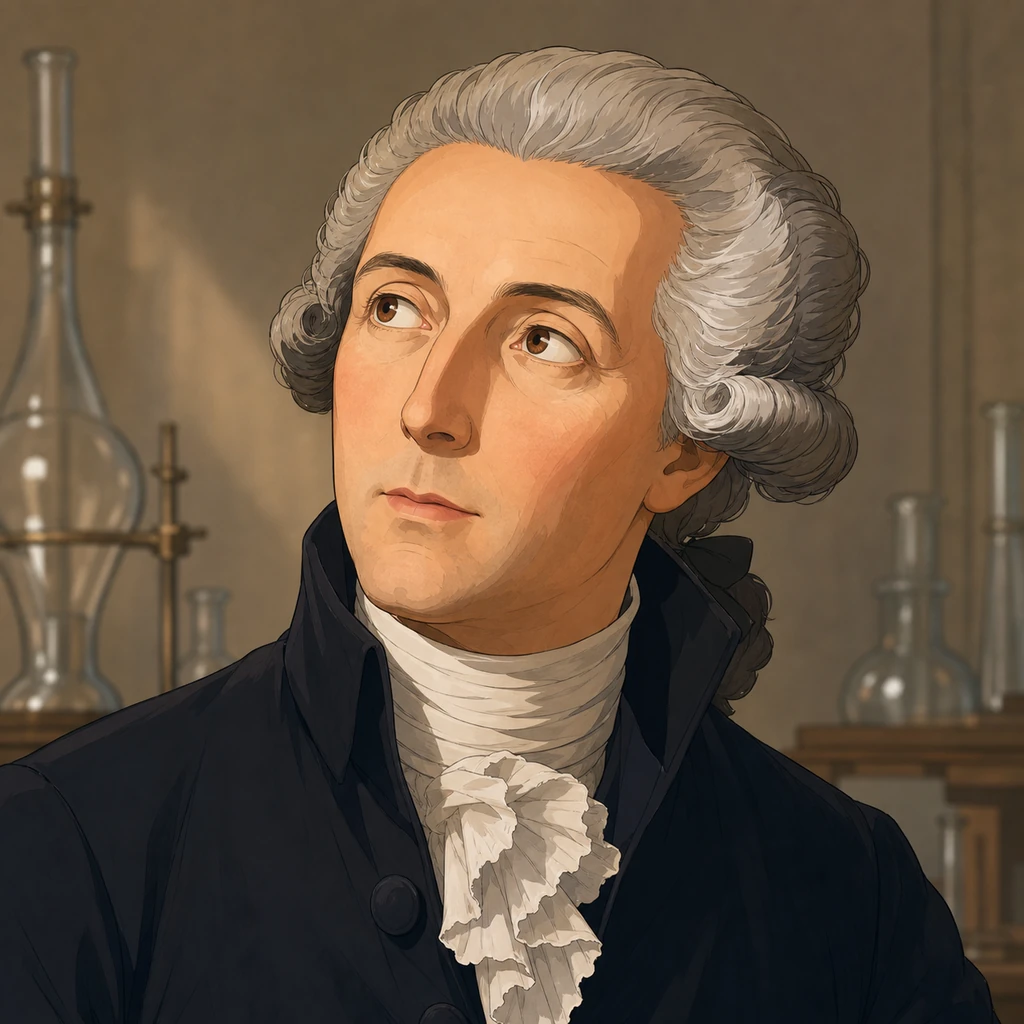
Antoine Lavoisier
Helping create modern chemistry and discovering the role of oxygen in chemical reactions
- Lived
- 1743–1794
- From
- French
- Reading time
- About 4 min
- Reading guide
- Independent-reader guide
Watch Antoine Lavoisier's story unfold
Why this story matters
A life worth remembering
Helping create modern chemistry and discovering the role of oxygen in chemical reactions
Think about it
What did you notice?
- Which moment changed the direction of this person's life?
- Which achievement or idea do you think mattered most?
- What is one question you would ask them?
Prefer to read? Open the complete biography transcript
From Law Lessons to Scientific Questions
On a balance in eighteenth-century Paris, Antoine-Laurent Lavoisier turned air, water, and metal into numbers—and those numbers helped transform chemistry. He was born in Paris on August 26, 1743. His mother died when he was five, and he grew up in a comfortable family of lawyers. At the Collège Mazarin, he studied law but also attended courses in mathematics and natural science. He earned his law degree in 1763, then explored France's rocks and minerals with geologist Jean-Étienne Guettard.
In 1768, at age 25, Lavoisier was elected to the Académie des Sciences. That year he also joined the Ferme Générale, a private organization that collected taxes for the French monarchy. The job gave him money for scientific equipment, but it later tied his life to an unpopular and unequal system.
Weighing Air, Fire, and Water
Lavoisier married Marie-Anne Paulze in 1771. She learned chemistry, translated scientific writings, recorded experiments, and drew laboratory equipment. Their work was a collaboration, not a one-person story. In 1775, Lavoisier became an administrator of France's gunpowder works and built a well-equipped laboratory at the Paris Arsenal. There he made careful measurements with balances and included gases when counting the materials in a reaction.
Other researchers, including Carl Wilhelm Scheele and Joseph Priestley, had produced the gas now called oxygen before Lavoisier explained its role. After Priestley described his experiment in Paris in 1774, Lavoisier repeated related tests. He showed that burning did not release an imaginary substance called phlogiston. Instead, materials combined with part of the air. This explained why some metals gained mass when heated and why oxygen mattered in both combustion and breathing.
A New Language for Chemistry
During the 1780s, Lavoisier used experiments to show that water was a compound made from hydrogen and oxygen rather than a basic element. He helped give those gases their modern names. With Louis-Bernard Guyton de Morveau, Claude-Louis Berthollet, and Antoine-François de Fourcroy, he introduced a more orderly chemical naming system in 1787. Clear names made it easier for researchers in different places to discuss the same substances.
His 1789 Traité Élémentaire de Chimie organized this new chemistry around measurement, experiments, and an operational idea of an element: a substance that chemical analysis had not broken into anything simpler. Its table listed 33 “simple substances.” Some entries, such as heat and light, were wrong, reminding us that science improves by correcting earlier models. Marie-Anne prepared thirteen folding engravings of laboratory apparatus for the book.
Revolution, Loss, and a Lasting Method
When the French Revolution began, Lavoisier served on the Committee of Weights and Measures, which helped develop the metric system. Yet his earlier work for the Ferme Générale made him a target during the Revolution's most violent period. He was arrested in 1793 and guillotined on May 8, 1794, with other former tax farmers. His death was a political execution, not the result of a scientific dispute.
Lavoisier's wider contribution was a way of doing chemistry: measure every material carefully, test explanations, use clear names, and publish methods others can examine. His conclusions were not all perfect, and his achievements depended on colleagues, especially Marie-Anne. Still, the combination of precise balances, shared language, and revisable ideas helped chemistry become the quantitative science students practice today.
Did you know?
Fun facts about Antoine Lavoisier
-
Lavoisier earned a law degree in 1763 before choosing scientific work.
-
He joined the Académie des Sciences in 1768 at age 25.
-
Marie-Anne Lavoisier prepared thirteen folding engravings for the 1789 chemistry textbook.
-
The names oxygen and hydrogen came from Greek roots meaning “acid former” and “water former.”
-
Lavoisier's 1789 table listed 33 “simple substances,” including some ideas later shown to be incorrect.
Learn & remember
Make the story yours
4 min read · Independent-reader guide
Three things to remember
- Known for: Helping create modern chemistry and discovering the role of oxygen in chemical reactions
- Lived: 1743–1794
- From: French
Words to know
Open a word for a short explanation.
revolution
A major and often rapid change in government or society.
Quick check
What do you remember?
Think of an answer, then open each card to check.
What is Antoine Lavoisier best known for?
Helping create modern chemistry and discovering the role of oxygen in chemical reactions
When did Antoine Lavoisier live?
1743–1794
What place or nationality is connected to this story?
French
Biography
Robert Boyle
He helped create modern chemistry and discovered Boyle’s Law about gases.
Biography
Louis Pasteur
Proving that germs cause disease and creating pasteurization to keep food safe
Biography
Voltaire
A famous writer and thinker who used stories and ideas to support freedom of thought, learning, and fairness.
Biography
Enrico Fermi
Helping discover how atoms work and creating the first controlled nuclear reaction.
Biography
Benjamin Franklin
A famous American inventor, writer, and leader who helped shape the United States.
Biography
Galileo Galilei
Helping people understand the sky by improving the telescope and studying space.
One story at a time
Who will you discover next?
Explore inspiring lives across science, art, history, music, and more.