
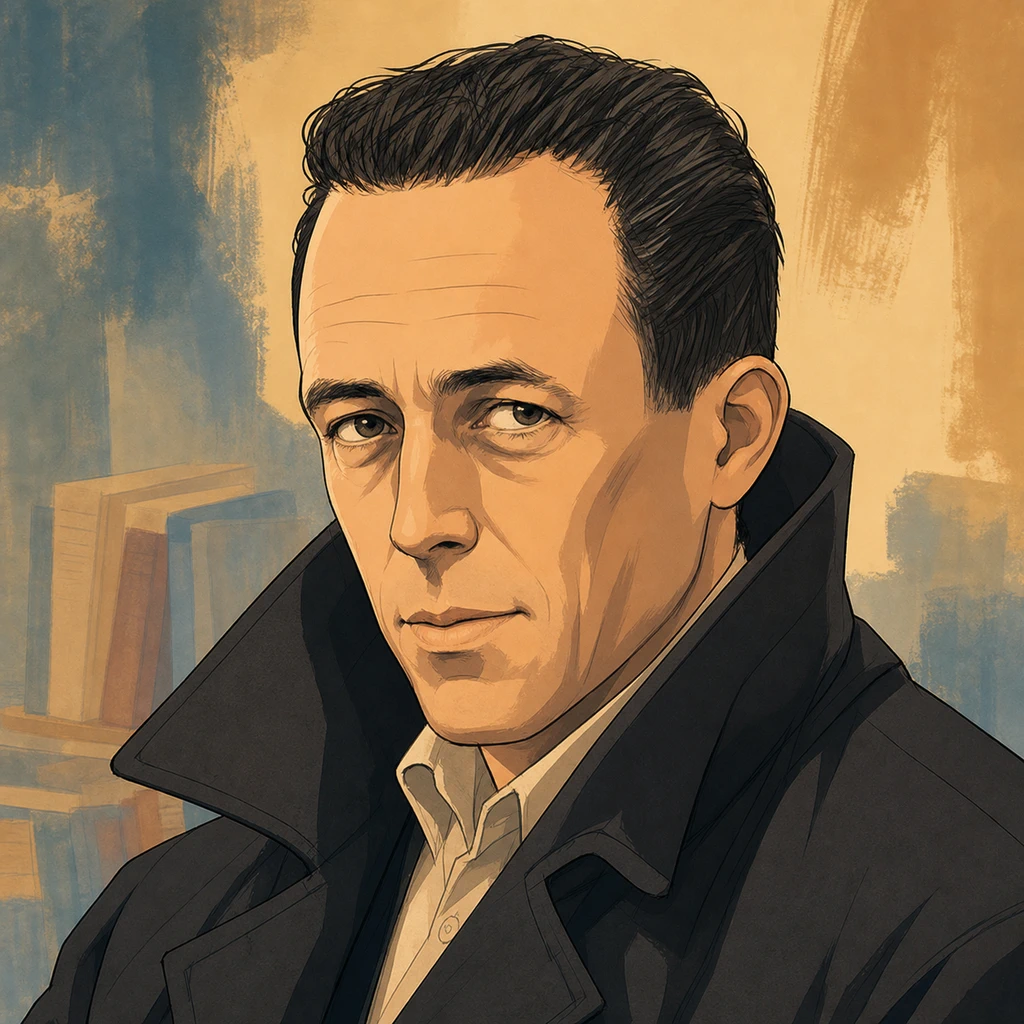
Biography for young readers
Albert Camus
A famous writer who shared big ideas about life through stories and won the Nobel Prize in Literature.
- Lived
- 1913–1960
- From
- French
- Reading time
- About 3 min
- Reading guide
- Advanced vocabulary
Watch Albert Camus's story unfold
Why this story matters
A life worth remembering
A famous writer who shared big ideas about life through stories and won the Nobel Prize in Literature.
Think about it
What did you notice?
- Which moment changed the direction of this person's life?
- Which achievement or idea do you think mattered most?
- What is one question you would ask them?
Prefer to read? Open the complete biography transcript
From Mondovi to an Algiers Classroom
Albert Camus began life far from the Paris book world that later made him famous. He was born on November 7, 1913, in Mondovi, in French-ruled Algeria, a country in North Africa then controlled by France. His father, Lucien, died in 1914 after being wounded in the First Battle of the Marne, so Albert grew up with little money in the Belcourt neighborhood of Algiers. A primary-school teacher named Louis Germain recognized his ability and helped him compete for a scholarship to continue his education. The scholarship allowed him to keep learning in secondary school and encounter a much wider world of books.
A Goalkeeper, Student, and Reporter
As a teenager, Camus played goalkeeper for the junior team of Racing Universitaire d'Alger. Tuberculosis struck when he was 17, interrupting school and ending his hopes of playing serious football, but he returned to his studies. At the University of Algiers, he studied philosophy and completed his degree in 1936 while also becoming involved in theater. He then wrote for the newspaper Alger Républicain, reporting on poverty and political conditions in colonial Algeria before the paper was banned and he moved to France in 1940.
Books and Resistance in Wartime
Camus reached a wide audience in 1942 with two very different books: the novel The Stranger and the essay The Myth of Sisyphus. Both examined what he called the absurd—the clash between people's wish for clear meaning and a world that offers no simple answers. During Nazi Germany's occupation of France, he joined the Resistance newspaper Combat and became one of its editors, using journalism to argue against oppression. His 1947 novel The Plague tells of a fictional epidemic in Oran and follows people who choose cooperation and steady work in the face of suffering.
A Nobel Prize and Questions That Remain
In 1957, at age 44, Camus received the Nobel Prize in Literature for writing that examined the moral problems of his time. He wrote novels, plays, essays, and journalism, and although people often called him an existentialist, he rejected that label. Camus died in a car crash in France on January 4, 1960, at age 46, leaving the novel The First Man unfinished; it was published decades later. His views, including his responses to colonial Algeria and political violence, are still debated, but his wider contribution endures in the questions he asked about courage, responsibility, freedom, and how people can act humanely when no answer is easy.
Did you know?
Fun facts about Albert Camus
-
Albert Camus played goalkeeper for the junior team of Racing Universitaire d'Alger before tuberculosis ended his serious football playing.
-
He published both The Stranger and The Myth of Sisyphus in 1942.
-
Camus wrote for the French Resistance newspaper Combat and later became one of its editors.
-
He was 44 years old when he received the 1957 Nobel Prize in Literature.
-
Camus rejected the existentialist label even though his work explored some questions associated with existentialism.
Learn & remember
Make the story yours
3 min read · Advanced vocabulary
Three things to remember
- Known for: A famous writer who shared big ideas about life through stories and won the Nobel Prize in Literature.
- Lived: 1913–1960
- From: French
Words to know
Open a word for a short explanation.
philosophy
The study of big questions about knowledge, values, and existence.
Quick check
What do you remember?
Think of an answer, then open each card to check.
What is Albert Camus best known for?
A famous writer who shared big ideas about life through stories and won the Nobel Prize in Literature.
When did Albert Camus live?
1913–1960
What place or nationality is connected to this story?
French

Biography
Jean-Paul Sartre
A famous thinker and writer who shared big ideas about freedom and choice
Biography
Émile Zola
A famous French writer who told powerful stories about real life and stood up for fairness.

Biography
Paulo Coelho
A famous writer who created inspiring stories like The Alchemist
Biography
Gabriel García Márquez
A famous writer who used magical realism to tell unforgettable stories and won the Nobel Prize in Literature.

Biography
William Faulkner
Writing famous novels and stories about life in the American South and winning the Nobel Prize in Literature.
Biography
Honoré de Balzac
A famous French writer who created a huge collection of stories about everyday life called La Comédie humaine.
One story at a time
Who will you discover next?
Explore inspiring lives across science, art, history, music, and more.