Behind the Panels
Murasaki Shikibu was a Japanese writer and court attendant whose Tale of Genji became one of the most influential works of world literature. This illustrated biography follows her learning, family life, service to Empress Shōshi and literary legacy. Her personal name and exact birth and death dates are uncertain. Scholars also disagree about when individual parts of the tale were composed.
The court scenes and the writer’s appearance are imaginative historical reconstructions. The panels summarize evidence rather than reproduce an eyewitness record. The moonlit origin story at Ishiyamadera is explicitly a later legend. Genji and the other figures inside her novel are fictional, not people from her biography. The title “world’s first novel” depends on definitions; we use the more cautious description “an early psychological novel.”
Her diary recalls learning Chinese alongside her brother and later teaching the empress. Sources differ on the precise date she entered court; around 1006 follows translator Royall Tyler’s account. Her marriage, widowhood and daughter belong to the historical outline, but the domestic scenes are imagined. The record becomes uncertain after 1013: the chapter does not assign a definite death date.
The 54-chapter tale explores relationships, status, passing time and the costs of desire across generations. Its reception is not only the achievement of one author: copyists, readers, commentators and artists also preserved and reinterpreted it. Writing in Japanese kana was strongly associated with women’s literary culture, but this should not be read as a simple rule that men never read or wrote it.
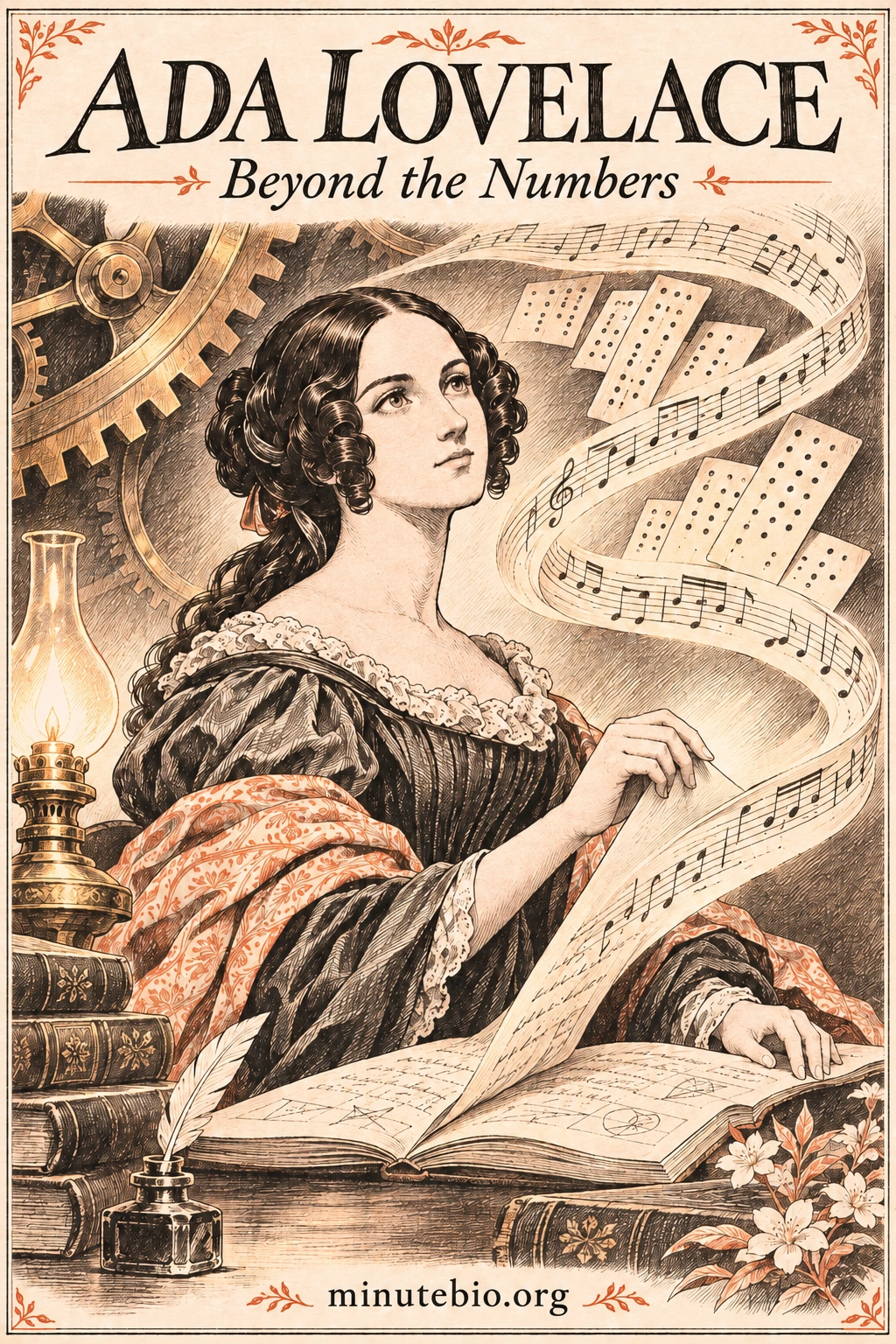
Image disclosure: All story pages, including the manga poster used as the featured image, are original AI-generated historical illustrations, reviewed for consistency. They are not surviving portraits, photographs, manuscript facsimiles or evidence of particular conversations. The brush marks are illustrative rather than transcriptions of historical text. No invented speech is presented as a quotation. The cover imagines Murasaki at a writing desk behind court screens.
Sources and further reading
- Royall Tyler, “Murasaki Shikibu,” Harvard Magazine: family, Echizen, marriage, court service, diary and uncertainties about composition.
- The Open University, “World-Changing Women: Murasaki Shikibu”: biographical overview and the limits of the surviving record.
- The Metropolitan Museum of Art, The Tale of Genji exhibition galleries: kana, court material culture, the Ishiyamadera legend and the tale’s artistic reception.
- Library of Congress, The Tale of Genji: an early-eleventh-century work and its continuing manuscript and print history.
- Kyoto National Museum, The Tale of Genji: Radiant Culture of the Japanese Imperial Court: the author, Empress Shōshi’s household and later reinterpretations.
Continue reading: Sor Juana Inés de la Cruz and Hokusai.