Summary:
A dare, a wartime dispensary, and two weeks on Dartmoor helped shape Agatha Christie’s first Poirot mystery.Agatha Christie wrote her first detective novel while working in wartime Torquay. What she noticed in the dispensary helped her create a puzzle that readers and Hercule Poirot could solve together.
Read how Beatrix Potter turned a letter into her first book.
Download this story as a PDF (4.6 MB).
Watch: Agatha Christie in 6 Minutes

A notebook and a shelf

In wartime Torquay, Agatha Christie worked in a hospital dispensary. Medicine bottles filled the shelves. Off duty, she was trying to write a detective story.

She wanted a puzzle the reader could solve. The trick was to let people see the same things as the detective without making the answer obvious.
A childhood by the sea

Agatha Mary Clarissa Miller was born in Torquay in 1890. The seaside town and the country around it would supply settings and details for stories she wrote as an adult.

She grew up at Ashfield, a Victorian house with a large garden. Her older brother and sister were often away, so she had to find ways to entertain herself.
Stories before school

Her mother, Clara, thought Agatha should wait to learn to read. Agatha taught herself instead. She was reading by about five, before her mother had planned to teach her.

Clara made up stories. By the time Agatha was old enough to tell her own, she had heard how a voice could make familiar things feel strange or surprising.
Starting with short stories

At eighteen, while ill with influenza, Agatha began writing short stories at Clara’s suggestion. It was something she could do at home while she recovered.

Family friend and novelist Eden Phillpotts encouraged her to keep writing. These early stories were not detective novels, but they gave her practice finishing a piece.
War comes to Torquay

Britain entered the First World War in 1914. In a town better known for visitors and sea air, rooms were needed for wounded soldiers.

Agatha volunteered as a nurse with a Voluntary Aid Detachment. Her work brought her into a field hospital in her hometown.
From the ward to the shelves

Wartime nursing was very different from writing at home. Agatha later moved from the ward to a dispensary set up in Torquay’s Town Hall.

There she helped the pharmacist. She learned that similar-looking bottles could contain very different medicines and that small details had consequences.
A detail worth noticing

The dispensary helped her decide how her mystery would begin: someone would die from poisoning. The story would turn on what the household noticed.

The central question was simple: what if a small detail that seemed ordinary at first turned out to explain everything?
Madge’s challenge

Agatha’s sister Madge challenged her to write a detective story. As the family account tells it, the reader should have the clues and still struggle to guess the culprit.

Agatha took up the challenge. She needed a house full of people with reasons to keep quiet, and someone stubborn enough to hear them out.
New neighbors

Belgian civilians fleeing the war settled in Torquay. Their presence gave Agatha an idea for a detective who had come to England from across the Channel.

She did not simply put a neighbor onto the page. She invented a man with a past and a set of habits all his own.
Enter Hercule Poirot

Hercule Poirot had been a Belgian police officer. He stood out in an English village, with his neat clothes, precise manners and carefully shaped moustache.

Poirot cared about order. When a room or a story was out of order, he wanted to know why. Even a seemingly fussy observation might be the first step toward the answer.
A country house called Styles

Agatha set the story at a country house called Styles Court. It looks peaceful from the outside. Inside, money and marriage give the household plenty to argue about.

A wounded officer named Hastings comes to stay. He knows some of the people at Styles and takes many of their explanations at face value.
The same clues

A woman dies, and several people in the house become suspects. The question is not just who had a reason. It is which details fit together.

Poirot examines what other people have seen and heard. The reader gets a chance to do the same work. There is no need to give away his answer here.
Away from interruptions

It was hard to concentrate while keeping up with her other work. Clara suggested that Agatha take some time away to finish the manuscript.

The break separated her from her usual routine. For a little while, she could give the same stubborn attention to her draft that Poirot gave to a room.
Two weeks on Dartmoor

Agatha went to the Moorland Hotel near Haytor. Outside were broad stretches of moorland and granite, far from the town and the hospital.

She had taken two weeks off. Her family’s account places the completion of the manuscript there in 1916.
The ending on paper

The book was called The Mysterious Affair at Styles. Its last pages had to show why clues that looked unrelated belonged to the same story.

An ending is also a test for the beginning. If a clue only makes sense because it appears at the last minute, the reader never had a real chance.
A manuscript leaves home

A finished manuscript still needed a publisher. Agatha sent the book out. Getting it written had been one problem; persuading someone to print it was another.

Readers would eventually meet Poirot in England and the United States. First the bundle of pages had to find someone willing to take the risk.
A long wait

The finished story did not appear for years. By the time readers met Poirot, the war that had helped shape the book was over.

John Lane of The Bodley Head accepted the manuscript in 1919 after other publishers turned it down. He signed Agatha to write five more books.
The first edition

Lane asked Agatha to change the ending. The explanation moved from a courtroom to the library at Styles, where Poirot could set out what happened.

The novel came out in the United States in 1920 and in Britain in 1921. What began as a challenge between sisters was now a book strangers could try to solve.
A detective worth keeping

Poirot did not stay at Styles. Agatha kept writing mysteries and brought him back. He became one of the most recognizable detectives in fiction.

She also created Miss Marple. But Styles first showed how much Poirot could do with a detail everyone else had seen.
A second look

Poirot’s habit of looking twice was as important as his moustache. A familiar room or an ordinary object could hide an explanation in plain sight.

That is the promise Agatha Christie made with her first mystery. You can turn back a page and see the clue again. It was there the first time, too.
Sources and illustration notes
- Agatha Christie Ltd: The Mysterious Affair at Styles
- Agatha Christie Ltd: official biography and early years
- Agatha Christie Ltd: Christie's Devon and the Haytor manuscript
- Agatha Christie Ltd: manuscript revisions and first publication dates
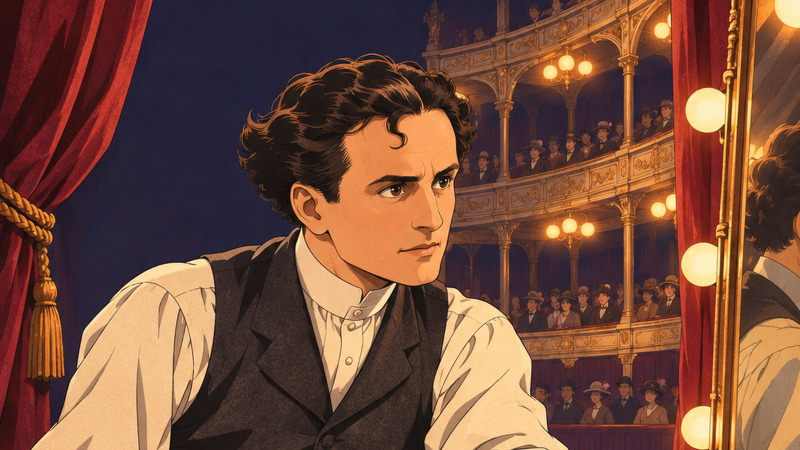
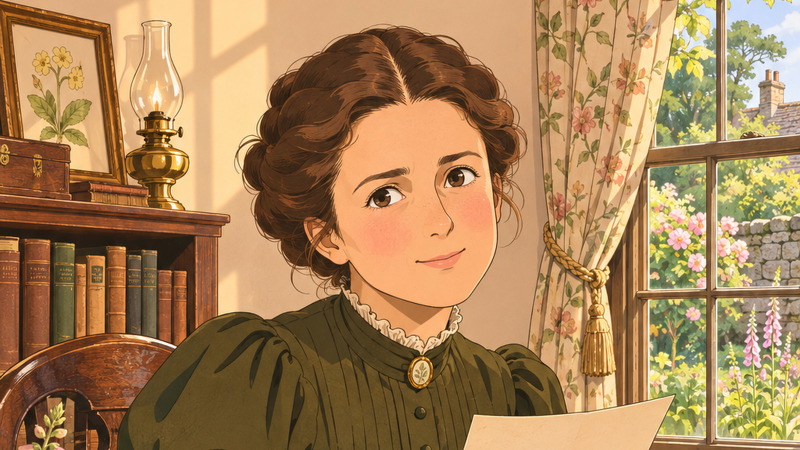
These original AI-assisted illustrations reconstruct representative scenes. They are not archival images or exact records of figures, buildings or equipment. Settings are representative; the scenes at Styles Court depict the novel’s fictional world.